Discriminative vs. Generative Models: Sorting vs. Creating
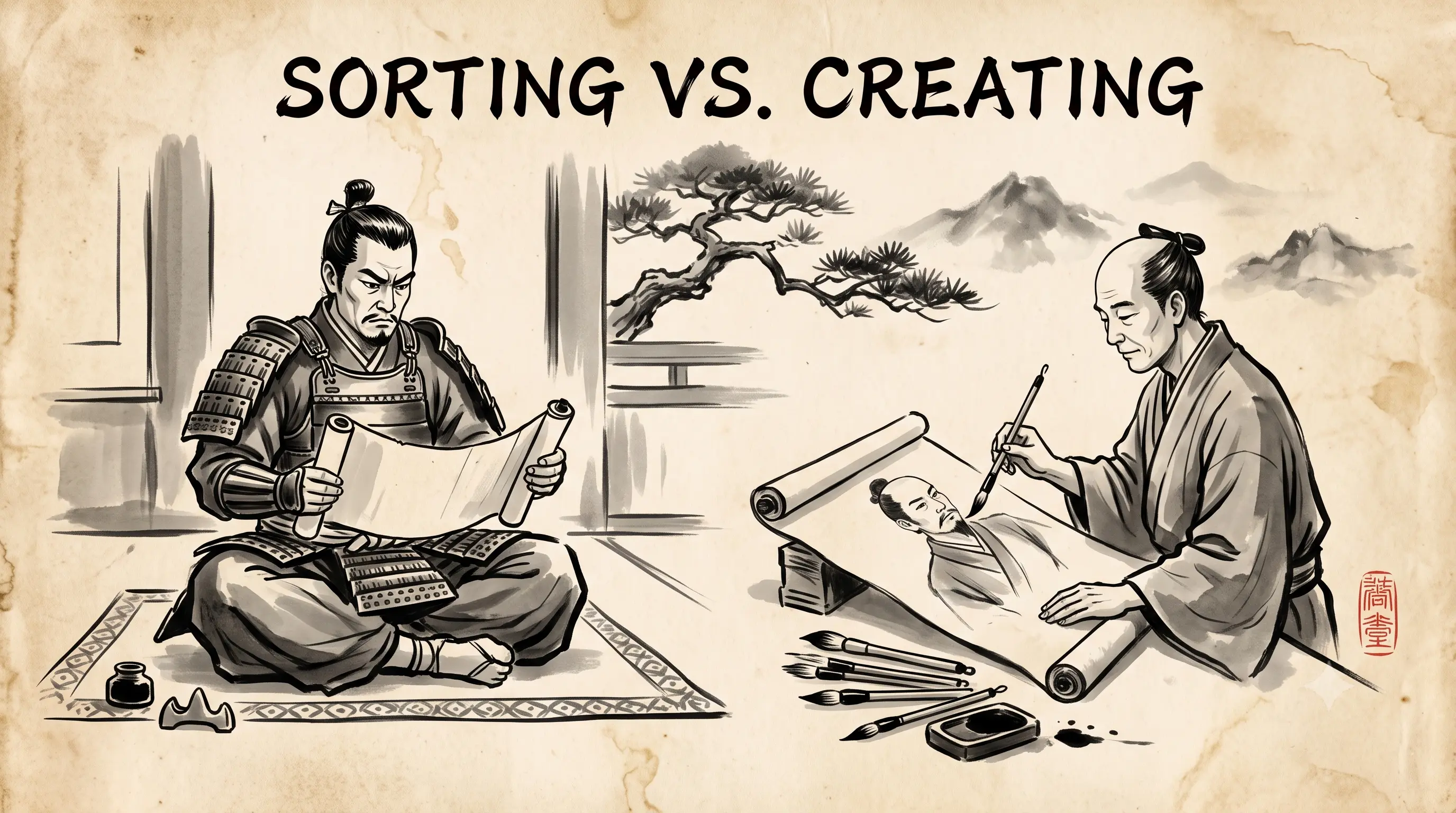
A hardened samurai guard stands at the city gates. His only job is to look at every traveler and answer one question: “Merchant or spy?” Over time, he becomes an expert at drawing an imaginary line between the two. He doesn’t know how to act like a merchant, nor how to forge a spy’s documents. He just knows the boundary.
Meanwhile, deep in the city, a master artisan sits in his studio. He isn’t interested in sorting people. He has spent his entire life studying the exact proportions, clothing, and expressions of every person in the city. When he puts his brush to a scroll, he can paint a completely new, hyper-realistic portrait of a person who has never actually existed.
The Reality
In the world of machine learning, these are the two fundamental ways to handle data.
The samurai guard is a Discriminative Model. It takes input data and predicts a label. It looks for the boundary between classes (like “cat” vs. “dog”, or “spam” vs. “not spam”). It’s highly efficient, but its understanding of the world is limited to recognizing the differences between things.
The artisan is a Generative Model. Instead of just learning where the boundary is, it learns the entire underlying distribution of the data. It learns the “essence” of what makes a cat look like a cat. Because it understands the complex statistical rules of the data itself, it can generate completely new, artificial examples that belong to that distribution.
The Why
For a long time, the tech industry was built on samurai guards. We used discriminative models for everything: fraud detection, image recognition, and recommendation algorithms. But they couldn’t create anything new.
The recent AI revolution happened because we finally figured out how to train the master artisans efficiently—giving us tools that don’t just categorize our world, but generate new versions of it.
The Takeaway
Discriminative models draw boundaries between things; Generative models learn how to paint the things themselves.
AI specialists call it: Discriminative vs. Generative Modeling
Discriminative models learn the conditional probability $P(Y|X)$ to classify data, while generative models learn the joint probability $P(X, Y)$ to understand how the data was generated.
💬 What’s a task in your daily work that currently requires a “samurai guard”, but you wish you had a “master artisan” for?
Part 1 of 14 | #GenerativeModelsForHumans
#ai_edu Based on Stanford and industry lectures