Specify the Problem: Don't Build a Warp Drive for a Grocery Run
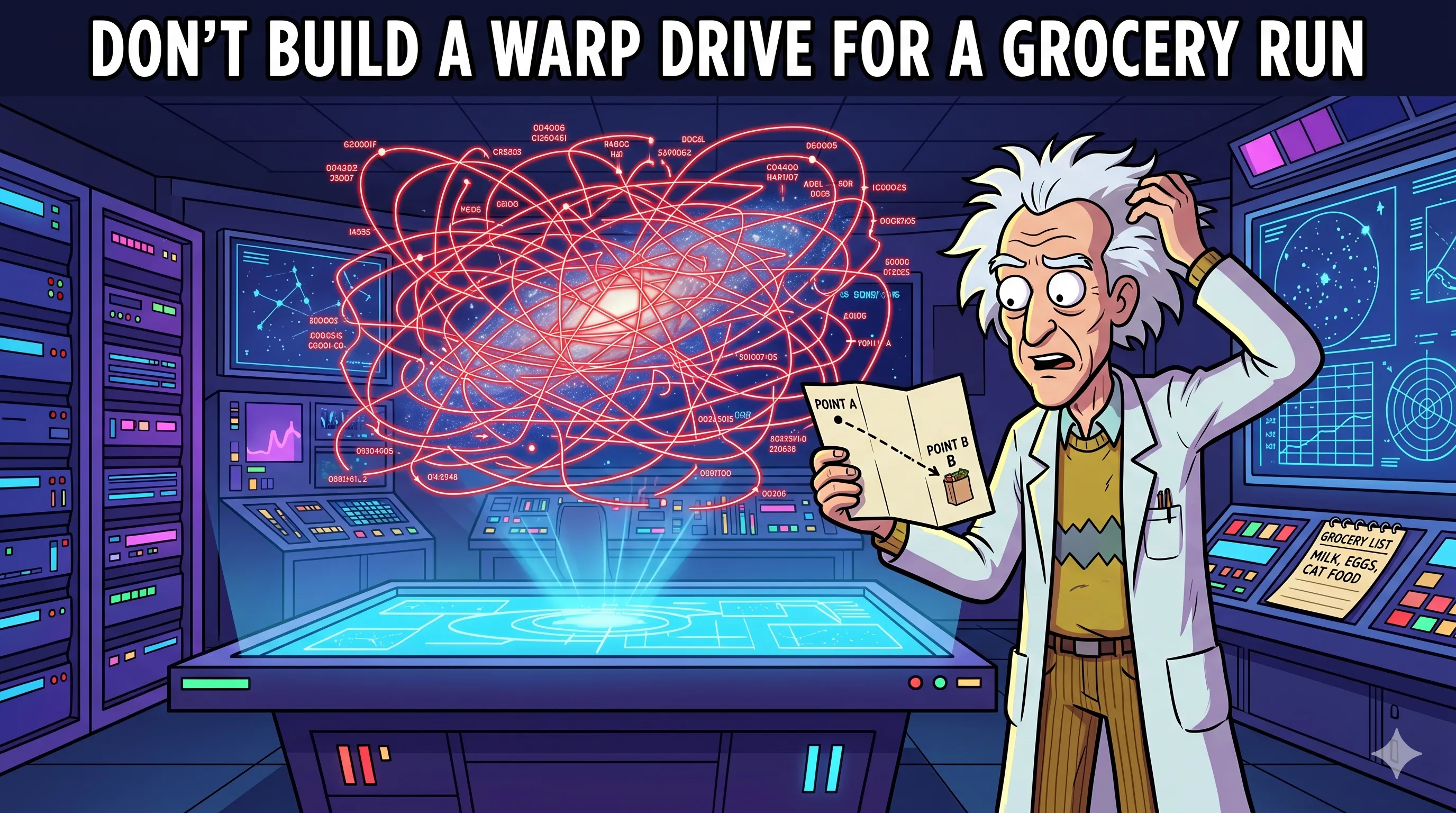
Our Chief Engineer just spent six months and four million credits building a Quantum-Tachyon Warp Drive. It bends space and time, looks incredibly cool, and requires the energy of a small sun to operate.
The problem? The client just wanted a drone to deliver a pizza to the moon base next door. We built a hyper-drive for a grocery run.
The Scenario
This happens every day in AI development. Founders hear about the latest “Generative Multimodal Neural Network” and immediately try to jam it into their product. They start building the model before they even know what the cargo is.
In the Deep Learning Lifecycle, before you collect a single piece of data or write a single line of code, you must SPECIFY THE PROBLEM.
The Reality
AI is a tool, not a strategy. You must define exactly what the machine needs to do in plain, boring language.
- Do we need the ship to classify cargo? (Is this box toxic or safe?)
- Do we need the ship to predict arrival time? (Regression analysis.)
- Do we need the ship to generate a new route? (Generative AI.)
If the problem is “sort the red boxes from the blue boxes,” you don’t need a multi-billion parameter neural network. You might just need a simple algorithm (or a color sensor).
The Why
Specifying the problem clearly dictates what kind of data you need to gather. If you don’t know the destination, you can’t plot the map. If you start gathering data and building models without a precise problem statement, you will end up with a brilliant AI that solves a problem nobody actually has.
The Takeaway
Fall in love with the delivery route, not the spaceship. Never build a complex AI model when a simple “if/then” statement will do the job.
AI specialists call it: Problem Formulation Problem formulation is the process of translating a high-level business objective into a specific, measurable, and solvable machine learning task (e.g., classification, regression, clustering).
💬 Have you ever seen a team spend months building a “Quantum AI” feature when a simple database query would have worked perfectly?
Part 4 (Specify the Problem) of 20 | #DLLifecycleForHumans #ai_edu Based on CS230 Stanford lectures