The Generator: From Concept to Canvas
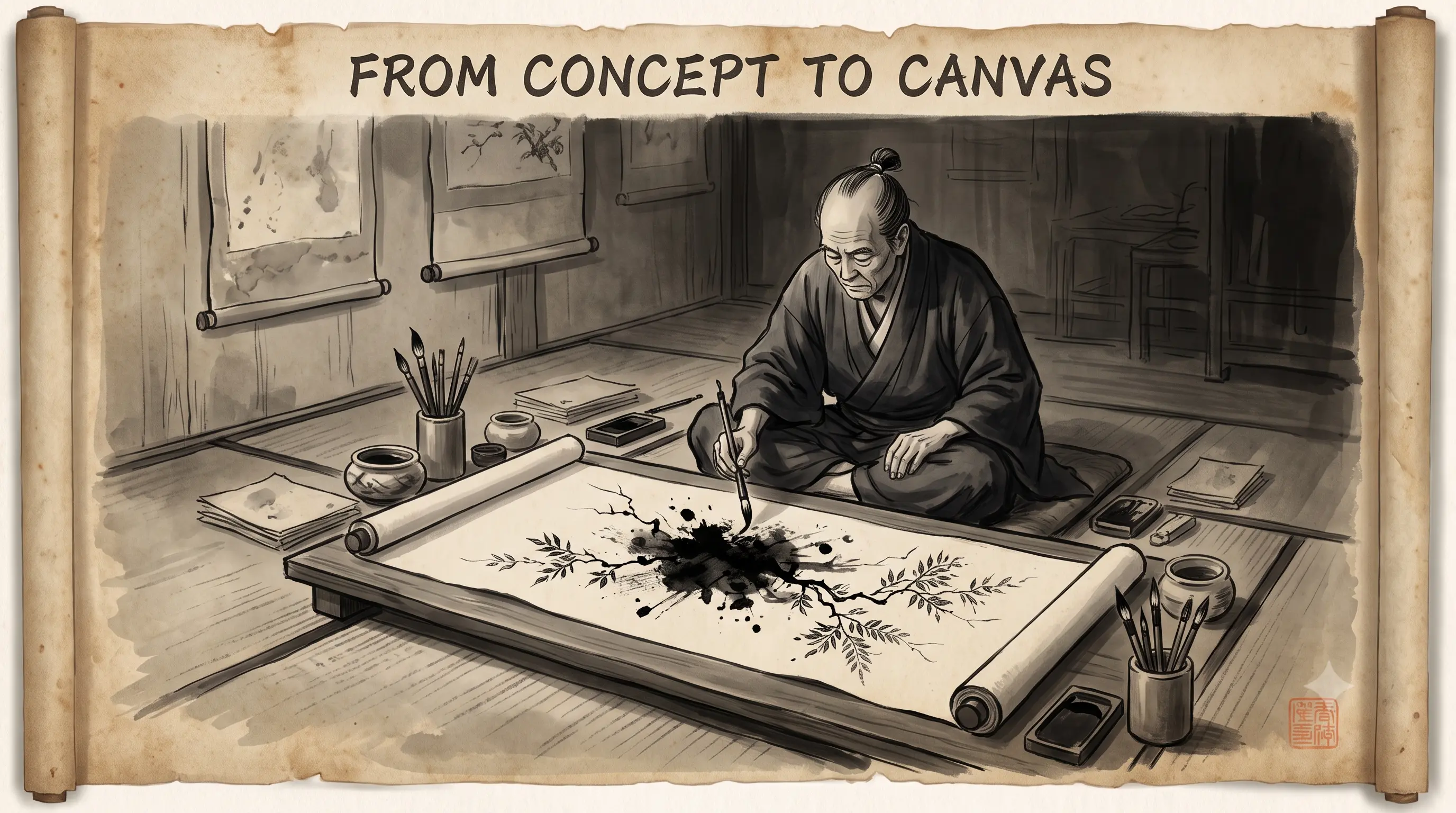
Deep in a hidden cellar, an ambitious art forger stands before a massive, empty scroll. He doesn’t start by carefully drawing an outline. Instead, he takes a small, seemingly random splash of ink and drops it in the exact center.
To an untrained eye, it’s just a chaotic smudge. But in his mind, that smudge contains the “seed” of the entire painting. Step by step, he works outward from that tiny splash. He expands the ink, pulling out broad shapes, then refining them into branches, then leaves, and finally delicate veins. He takes something small and meaningless and scales it up into a high-resolution, hyper-realistic masterpiece.
The Reality
In a Generative Adversarial Network (GAN), this artist is called the “Generator.”
The Generator’s job is to create fake data (like a photo of a face) that looks so real it fools everyone. But it doesn’t start with a blank canvas. It starts with a short string of completely random numbers, called a “noise vector.”
Through a mathematical process called “upsampling” (specifically, using transposed convolutional neural networks), the Generator takes that tiny, compressed string of noise and progressively expands it. It turns those random numbers into a rough block of pixels, then a blurry shape, and finally a crisp, high-resolution image.
The Why
Why start with random noise? Because if the Generator always started with the same blank canvas, it would always paint the exact same picture. The random noise acts as the “seed” of inspiration. By slightly changing the numbers in the initial noise splash, we force the Generator to expand the image in a completely different direction—giving us an infinite variety of unique, high-quality images instead of just one.
The Takeaway
The Generator doesn’t draw lines; it expands tiny drops of chaos into detailed reality.
AI specialists call it: The Generator (Upsampling Network)
The Generator in a GAN typically uses transposed convolutions to upsample a low-dimensional latent noise vector (z) into a high-dimensional data space (like an image), learning to map the prior distribution to the complex target data distribution.
💬 If you had to create a masterpiece starting from a single random ink splash, what is the first shape you would try to pull out of it?
Part 4 of 14 | #GenerativeModelsForHumans
#ai_edu Based on Stanford and industry lectures