The Engine Room: You Don’t Need to Invent the Turbine
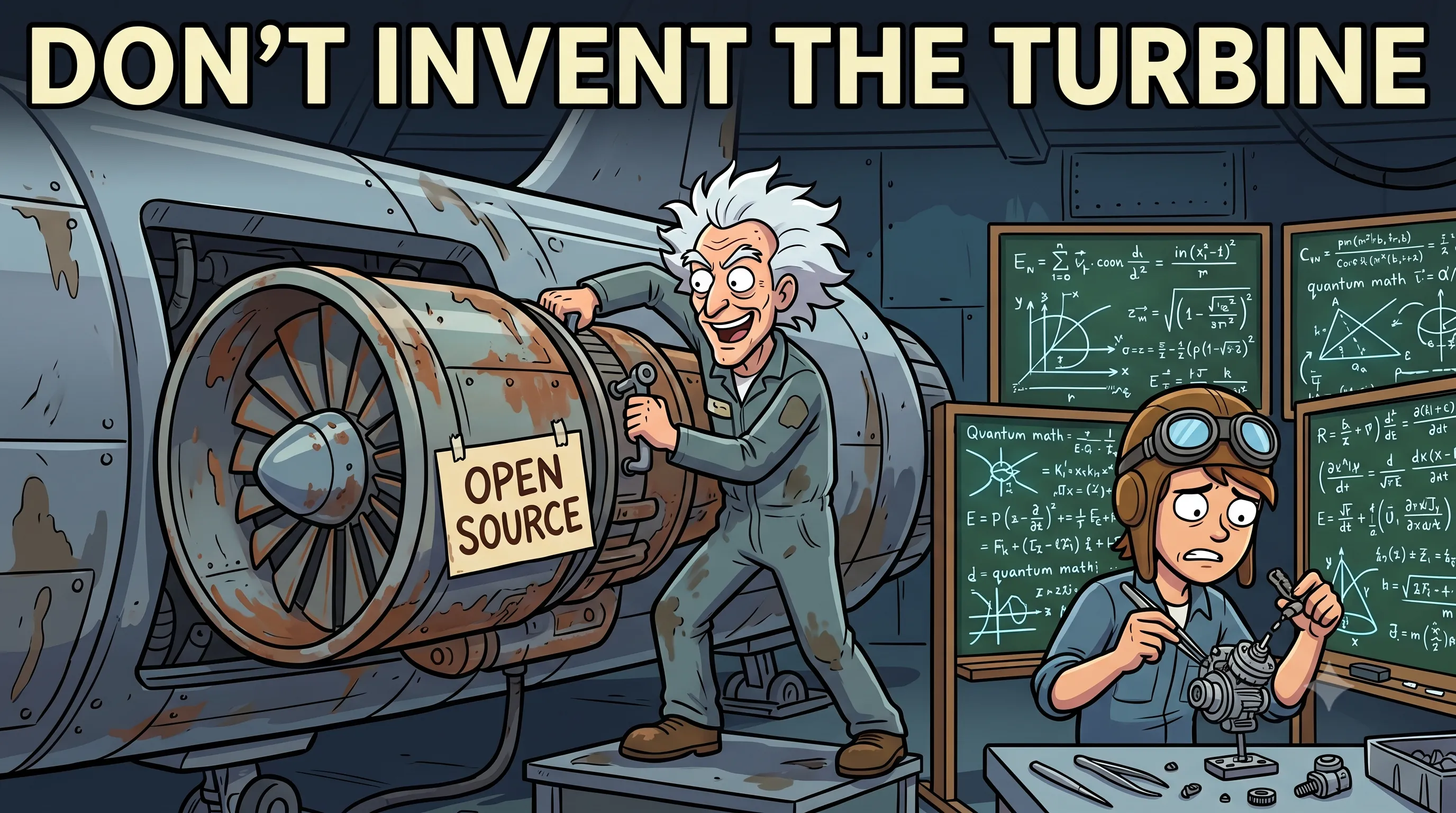
We have our map (the problem) and we’ve scavenged enough plasma-rocks (the data) to get started. Now, we need the actual Engine to process this fuel.
Our junior mechanic is currently locked in his quarters, surrounded by whiteboards covered in advanced quantum equations. He is trying to invent a completely new type of hyper-drive from scratch. He’s been in there for three weeks.
The Scenario
In AI, this is the “Model Design” phase. When founders hear they need an AI model, they often assume their developers need to invent a proprietary algorithm. They think they need to become AI researchers, write whitepapers, and build custom neural network architectures.
This is the fastest way to bankrupt a space agency.
The Reality
Unless you are Google or OpenAI, you should almost never design a new neural network architecture from scratch. If you need to process text (read distress signals), you use a Transformer (like GPT or BERT). If you need to process images (scan asteroids), you use a Convolutional Neural Network (like ResNet).
Your job isn’t to invent the turbine. Your job is to go to the open-source junkyard (like Hugging Face or GitHub), pull a pre-built, proven engine off the shelf, and bolt it into your ship.
The Why
In the DL lifecycle, the magic doesn’t happen because you invented a new math equation. The magic happens when you take an open-source model that already exists and fine-tune it on your specific, unique data.
The architecture is a commodity. The data is the competitive advantage.
The Takeaway
Don’t let your engineers reinvent the wheel. Find an open-source model that solves 80% of your problem, plug it in, and focus on the data.
AI specialists call it: Model Selection and Architecture Rather than designing models from scratch, practitioners typically select existing, state-of-the-art architectures (like Transformers or CNNs) that are proven to work for their specific data modality (text, audio, vision).
💬 When was the last time someone on your team spent weeks building a custom solution, only to realize an open-source tool already did it better?
Part 6 (Design Model) of 20 | #DLLifecycleForHumans #ai_edu Based on CS230 Stanford lectures