The Adversarial Game: An Escalating Duel
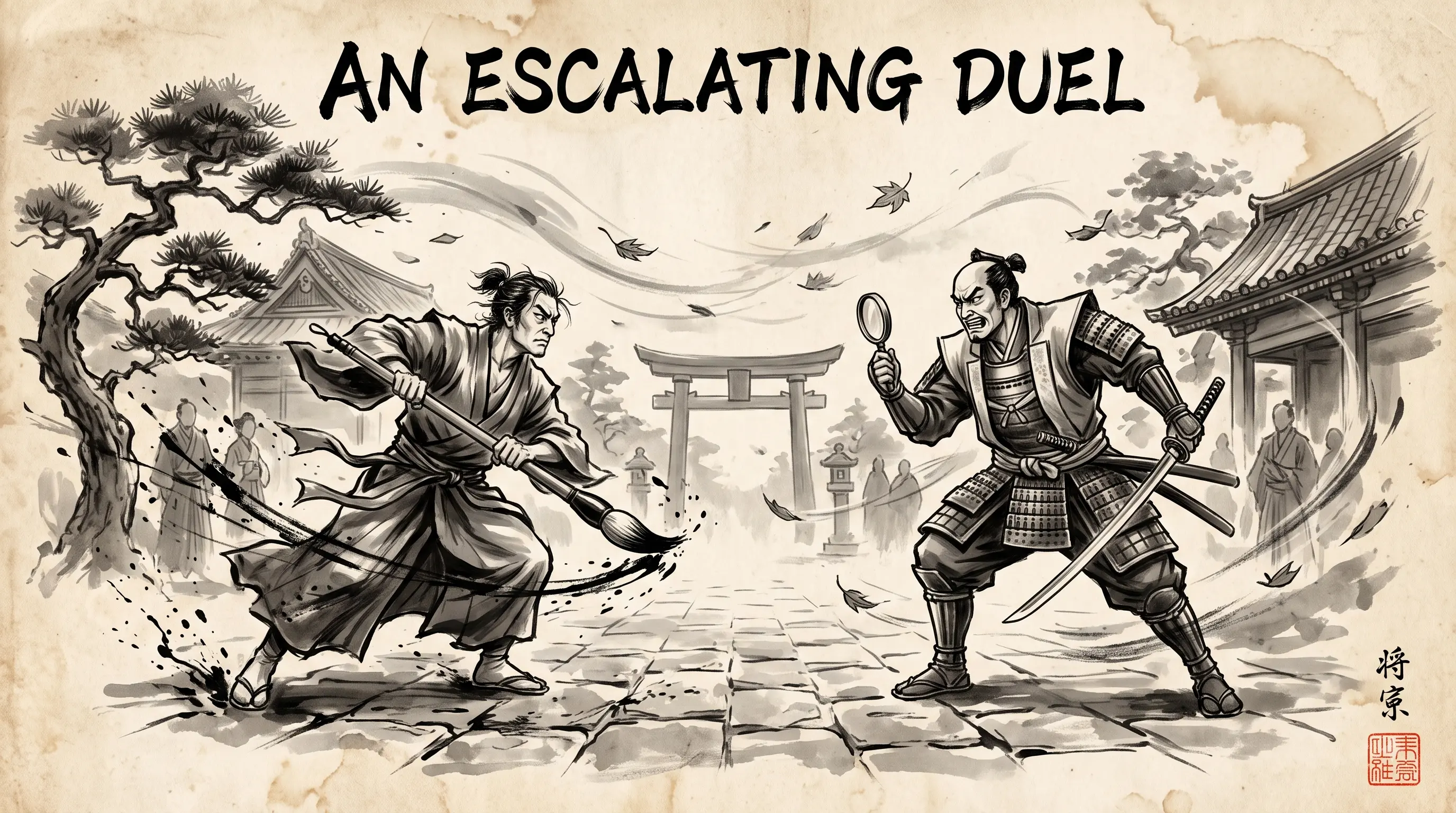
The art forger and the Shogun’s inspector are locked in an endless, high-stakes duel. It is a zero-sum game: if the forger succeeds in passing off a fake, he wins and the inspector loses. If the inspector catches the fake, he wins and the forger loses.
At first, the forger is terrible. His ink splashes barely look like trees, and the inspector catches them instantly. But the forger learns from every failure. He figures out exactly what the inspector is looking for (a specific curve, a type of shading) and corrects it.
Soon, the forger’s work is so good it slips past the inspector. Now it’s the inspector’s turn to adapt. He studies the new fakes even closer, finding new, microscopic flaws to expose them.
This back-and-forth escalation never stops. Because they are competing against each other, they force each other to achieve absolute perfection.
The Reality
In AI, this is the “Minimax” game at the heart of Generative Adversarial Networks (GANs).
“Minimax” comes from Game Theory. It means one player is trying to minimize the other player’s chances of winning, while maximizing their own.
The Generator (the forger) and the Discriminator (the inspector) are two separate neural networks trained simultaneously. They have completely opposite goals. The Generator is trying to maximize the Discriminator’s error rate (fool it). The Discriminator is trying to minimize its own error rate (catch the fakes).
The Why
This adversarial setup is brilliant because the models don’t need a human to tell them how to get better. The Generator’s “loss function” (how it measures failure) is literally tied to the Discriminator’s success. As the Discriminator gets smarter, it provides a continuously moving target for the Generator. It’s an automated evolutionary arms race happening inside a computer, resulting in AI that can generate hyper-realistic data.
The Takeaway
The most powerful way for an AI to learn isn’t by reading a textbook; it’s by fighting a relentless opponent.
AI specialists call it: Minimax / Adversarial Game
In a GAN, the training process is formulated as a minimax two-player game, where the Generator and Discriminator are trained jointly: the Generator minimizes the log-probability of the Discriminator being correct, while the Discriminator maximizes it, aiming for a Nash equilibrium.
💬 If you had to master a new skill in just one month, would you learn faster with a supportive teacher or a competitive rival?
Part 6 of 14 | #GenerativeModelsForHumans
#ai_edu Based on Stanford and industry lectures