Exploration vs. Exploitation: Why Champions Roll a Twenty-Sided Die
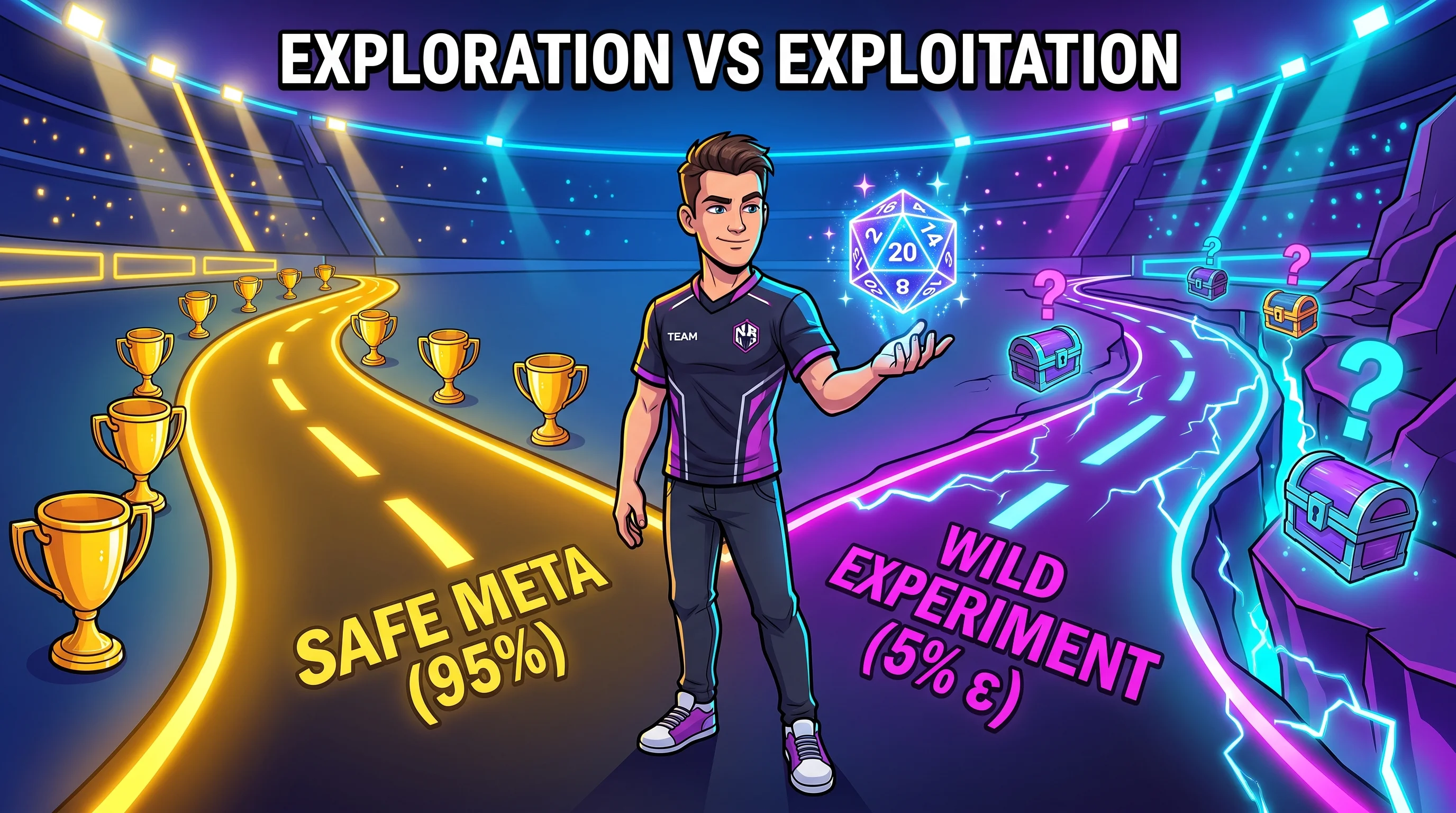
You find a café down the street that serves the best falafel wrap in the city.
For the next six months, every single time you go out for lunch, you order that exact wrap. You never leave disappointed. But you will also never discover the Vietnamese noodle shop two doors down with hot vegan Pho Cha that might have changed your life.
This is the classic dilemma between Exploitation and Exploration: do you milk the best thing you already know, or do you risk disappointment to search for something even better?
In competitive esports, this dilemma dictates tournament metas.
Every competitive game has a Meta—the Most Effective Tactic Available. It is the established combination of weapon buys, smoke lineups, and hero picks that statistically delivers the highest win rate. If a team only exploits the proven meta, they become a robotic machine: polished, consistent, and completely predictable. Opponents simply watch their match history, build a targeted counter-strategy, and dismantle them on stage.
Worse, a team that only plays what already works will never discover the game-breaking tactics that redefine the sport.
Yet if that same team plays every tournament match like an erratic lab experiment—trying random off-meta hero compositions with zero practice—they will crash out of the qualifiers before lunch.
Reinforcement Learning agents face this exact survival trap from their very first frame.
The Reality
If an AI agent only chooses the action with the highest estimated score (a purely greedy policy), it traps itself in a local optimum.
Imagine a racing game where an agent accidentally earns ten points by driving into a grass patch and collecting a tiny coin. If it only exploits what it knows, it will spend the rest of eternity driving straight into the lawn, convinced it found the greatest strategy on Earth, never discovering the actual asphalt race track ten feet away.
To break this trap, engineers equip agents with the Epsilon-Greedy strategy (written with the Greek letter ε).
At every single decision point, the agent rolls a metaphorical die:
- Most of the time (with probability 1 - ε), it exploits its training: it picks the absolute best move its neural network knows.
- But a small fraction of the time (with probability ε), it ignores all logic and takes a completely random action. It wanders down an unfamiliar corridor, tries an odd button combination, or peeks a bizarre angle.
During early bootcamp training, ε starts at 1.0: the agent behaves like a chaotic toddler, exploring everything at random. Over millions of practice rounds, ε gradually decays down to 0.05 or 0.01. On tournament day, the agent plays with master-level precision 95% to 99% of the time, while retaining a tiny spark of pure unpredictability.
The Why
True mastery requires an engine for curiosity.
The best esports dynasties do not win championships by strictly adhering to textbook playbooks. They win by executing the standard meta with ruthless discipline, while keeping a five-percent margin for wild, unexpected gambits that break the opponent’s mental composure.
Epsilon-greedy provides an artificial intelligence with that exact safety valve against dogmatic stagnation.
Where does this break down?
Standard epsilon-greedy exploration is notoriously naive. When the algorithm decides to explore, it treats every available action with equal weight. That means testing an innovative alternative route has the exact same probability as walking backward into a pit of molten lava. In complex games, uniform random exploration wastes enormous computing power on comical, suicidal mistakes. Modern research often supplements it with smarter alternatives like curiosity-driven exploration or Upper Confidence Bounds, which bias curiosity toward unfamiliar states that look promising rather than suicidal.
The Takeaway
Relying entirely on what already works makes you predictable; wandering aimlessly makes you useless. True progress happens when you run a proven system with a five-percent budget for chaos.
AI specialists call it: Exploration vs. Exploitation / Epsilon-Greedy Strategy / Epsilon Annealing
In value-based reinforcement learning, an agent faces the exploration-exploitation tradeoff. Under an ε-greedy policy, the agent selects action a = argmax_a Q(s, a) with probability (1 - ε), and samples uniformly from the action space with probability ε. Epsilon is typically scheduled via linear or exponential decay from an initial value (ε_start = 1.0) down to a terminal baseline (ε_end = 0.01 or 0.05), ensuring global policy discovery early in training and asymptotic convergence to near-optimal exploitation later.
💬 Have you ever stuck with a safe, familiar workflow for months, only to realize that a random, risky experiment you tried on a whim ended up saving you hours every week?
Part 8 of 15 | #ReinforcementLearningForHumans
#ai_edu Based on Stanford and industry lectures