AI That Does Stuff: Actual Stuff
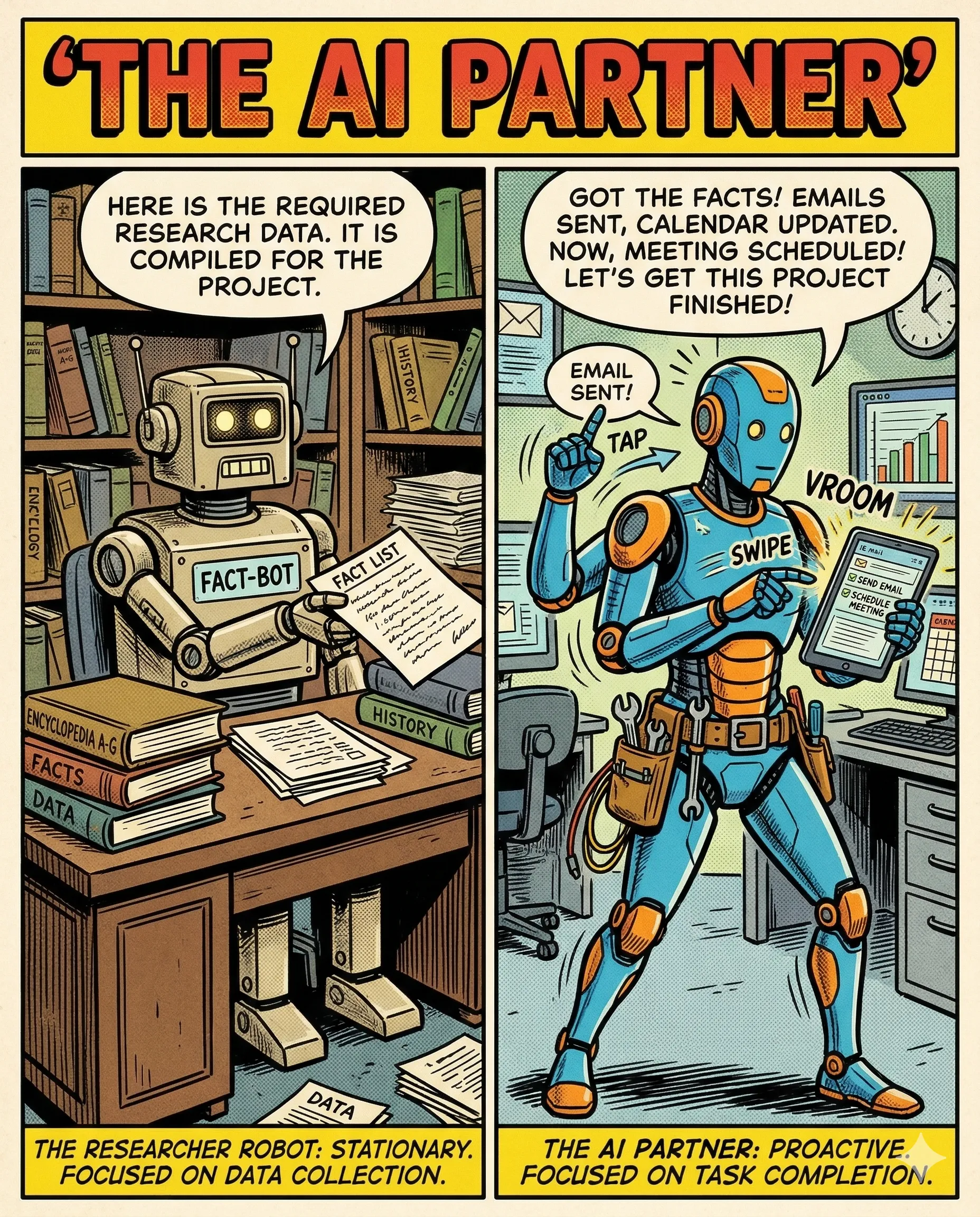
Imagine you have a brilliant researcher sitting in your office. This person is an expert at answering questions, but when you ask for a result, they only provide a list of facts. If you want to finish the project, you must still do all the work — you write the emails, you update the files, and you manage the schedule.
Now, imagine an Executive Assistant who has the authority to act. When you give them a goal, they plan the steps, use the necessary tools, and complete the task until it is done. They pick up the digital phone, send the emails, and verify the results.
This transformation from a “speaker” to a “doer” is the heart of Agentic AI.
The mechanism behind this is called the “Agentic Loop.” Standard AI works in a straight line: you ask, it answers. Agentic AI works in a circle: it creates a plan, takes an action, observes the result, and adjusts its next move. It “reasons” through a problem by looking at the outcome of its own actions. This allows the AI to use external tools like calculators, browsers, or company software to achieve a final goal rather than just providing words.
In practice, this turns a simple summary into a complete workflow. For example, a customer support agent identifies a shipping error in a user’s message. Instead of just telling you about the error, the agent automatically checks the tracking number, writes a draft apology, and updates the support ticket status. It handles the entire “boring” part of the job while you focus on the final approval.
Success happens when the AI moves from “knowing” to “executing.” You transition from an assistant who talks to a partner who finishes the mission.
The Takeaway: a standard AI is a book, but an agentic AI is a teammate with a toolkit.
Why This Matters for Your AI Product
Agentic AI is the architecture behind most of what people mean when they say “I want AI to run my business.” Here’s what to know before you build:
- Tools are the superpower: An agent is only as useful as the tools you give it — a calendar API, a CRM, a database. Connecting the right integrations is the real engineering work.
- The loop can fail: Because the agent acts on its own observations, errors can compound. A good agentic system includes checkpoints where a human reviews before any irreversible action is taken.
- Scope matters: Start narrow. An agent that does one workflow reliably is far more valuable than one that attempts everything and gets stuck halfway.
AI specialists call it: Agentic AI Workflows Systems where the AI is capable of planning and executing multi-step tasks using external tools to achieve a specific objective.
If you could give your AI one tool from your digital toolkit to use on its own, which one would it be?
Part 9 of 18 | #RAGforHumans