Latent Space Linearity: The Sliding Scale of Seasons
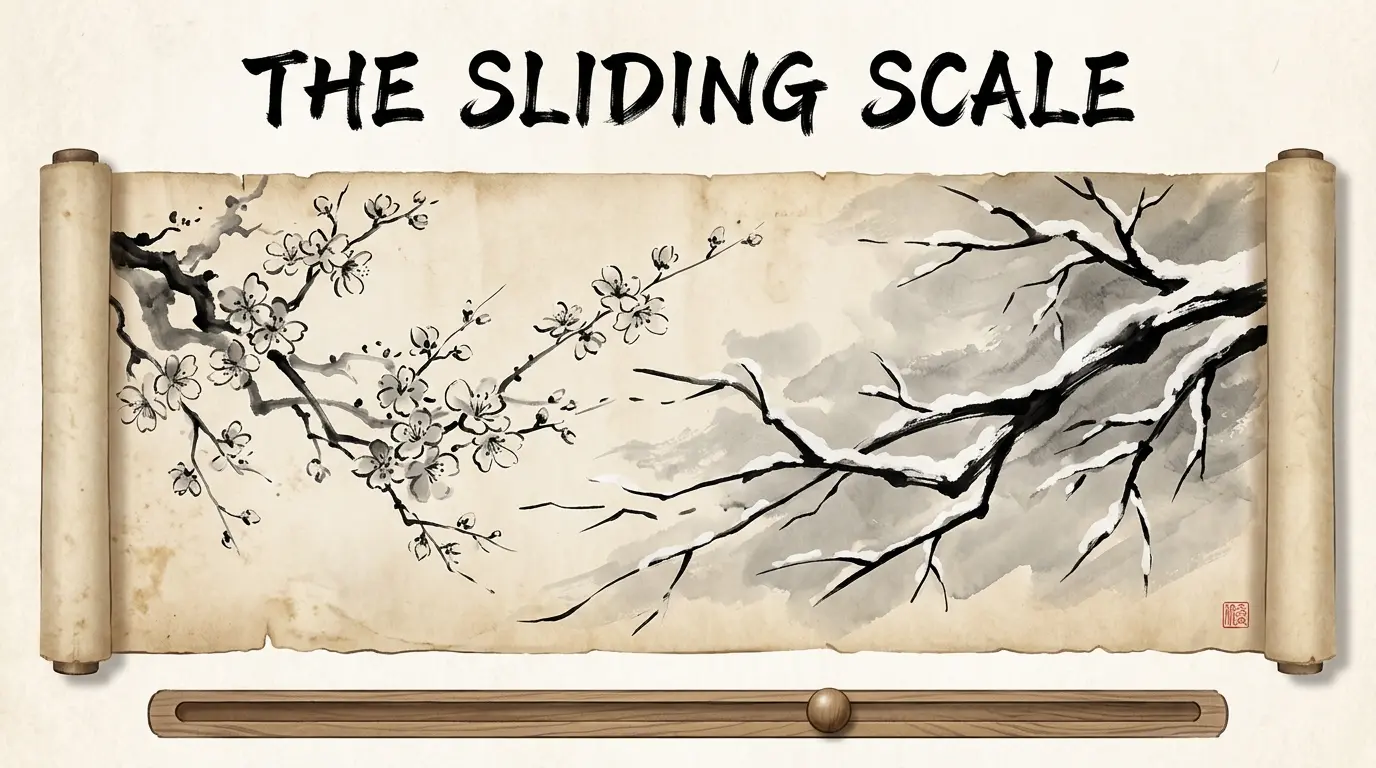
A master artisan has invented a magical wooden frame for his parchment scrolls. Along the bottom of the frame is a sliding wooden bead.
If the master slides the bead all the way to the left, the ink on the scroll shifts and morphs, arranging itself into a beautiful painting of cherry blossoms in Spring.
If he slides the bead all the way to the right, the ink flows and transforms into a stark, beautiful painting of snow-covered branches in Winter.
The magic happens when he slides the bead to the middle. The ink doesn’t just turn into a chaotic mess. Instead, it perfectly blends the concepts: the cherry blossoms slowly drop their petals, the branches become bare, and the first flakes of snow begin to fall. The transition is perfectly smooth and logical. The master hasn’t just memorized two paintings; he has mapped out a smooth, continuous path between the concept of Spring and the concept of Winter.
The Reality
In Generative AI, this smooth transition is called “Latent Space Linearity.”
The “latent space” is a compressed, high-dimensional map where the AI organizes all the concepts it has learned. In a well-trained model like a GAN or Diffusion model, this space isn’t just a random jumble of data. It organizes concepts logically.
If the AI has learned what a “smiling face” looks like and what a “frowning face” looks like, those concepts exist as specific points (coordinates) in the latent space. “Linearity” means that if you draw a straight line between the “smile” point and the “frown” point, and you generate images along that line, you won’t get garbage. You will get perfectly smooth, logical transitions: a big smile, a small smile, a neutral face, a slight frown, and a deep frown.
The Why
Latent space linearity is the ultimate proof that the AI isn’t just copy-pasting data from its training set. It proves that the model has built a structured, underlying understanding of the concepts. Because the space is linear and organized, we can perform “latent space math”—for example, taking the vector for [Man with Glasses], subtracting [Man], adding [Woman], and generating an image of a [Woman with Glasses]. This is what gives us the power to precisely edit and control AI-generated images.
The Takeaway
True mastery isn’t just knowing the beginning and the end; it’s understanding every step in between.
AI specialists call it: Latent Space Interpolation / Linearity
A well-trained generative model organizes its latent space such that semantic attributes (like age, gender, or lighting) correspond to linear directions. By interpolating (moving smoothly) between two latent vectors $z_1$ and $z_2$, the generator produces a continuous and semantically meaningful transition in the output space, demonstrating that the model has learned a structured representation of the data manifold.
💬 If you could have a “slider” for any concept to instantly edit your photos (like sliding from “casual” to “formal”), what slider would you want?
Part 9 of 14 | #GenerativeModelsForHumans
#ai_edu Based on Stanford and industry lectures