The Reverse Process: Pulling Ink from Water
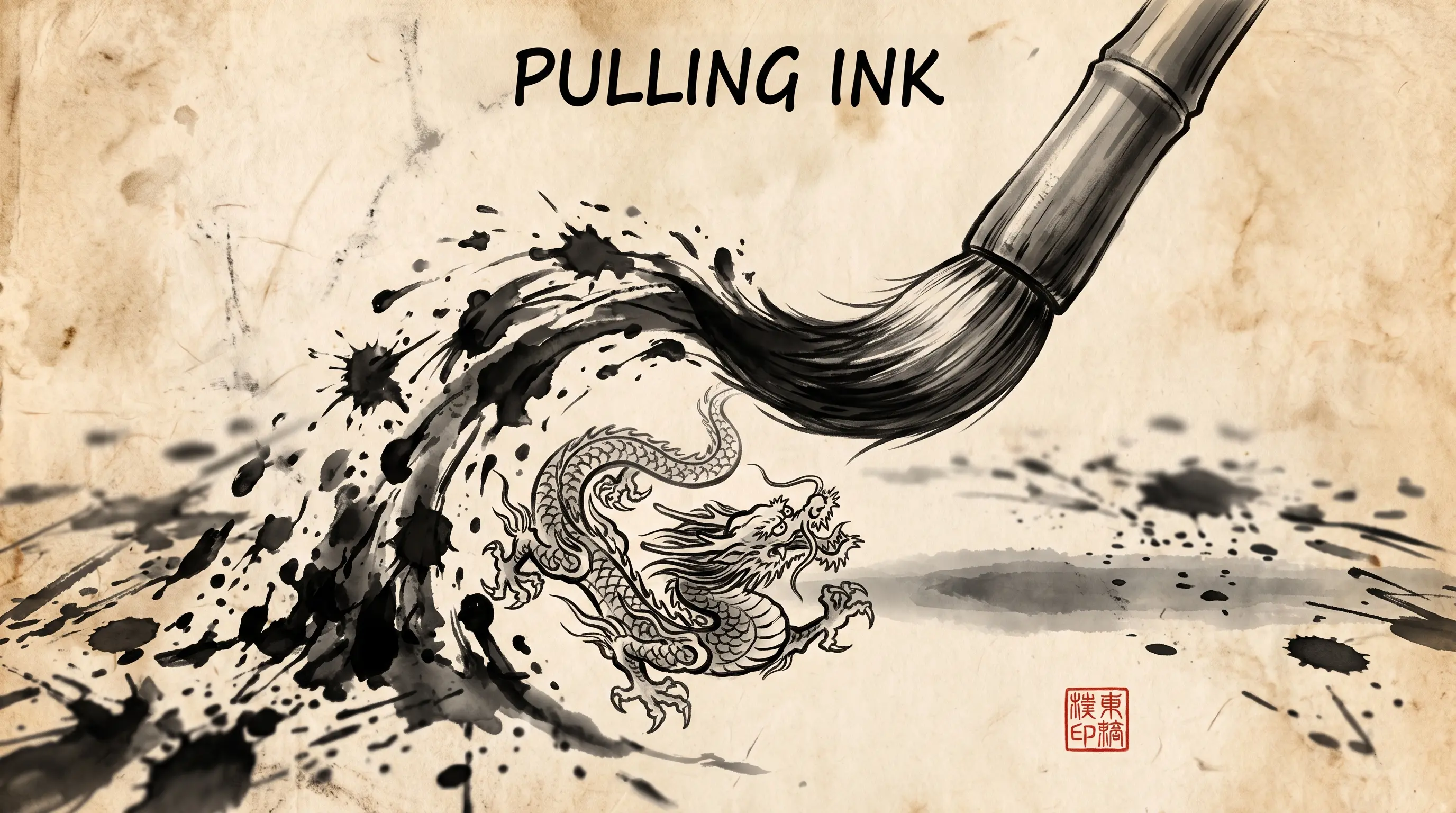
We saw the water mage destroy the beautiful painting of a dragon by carefully dropping black ink into the water, one drop at a time, until the bowl was completely dark and chaotic.
Now, he reveals the true purpose of his magic. He takes a completely new bowl, filled with nothing but pitch-black, chaotic ink water. There is no hidden painting at the bottom. It is just pure noise.
He dips a magical brush into the dark water. Because he spent so much time studying exactly how ink spreads and destroys an image, his magical brush knows exactly how to do the opposite. With a precise flick of his wrist, the brush extracts a single drop of black ink from the water.
The water becomes slightly clearer. He flicks the brush again, removing another drop of ink. And another.
Slowly, step-by-step, the darkness lifts. As the water clears, shapes begin to form at the bottom of the bowl. By reversing the exact steps of destruction, the mage pulls the chaos out of the water, leaving behind a perfectly clear, brand new painting of a dragon that never existed before.
The Reality
In Diffusion Models, this is called the “Reverse Diffusion Process” (or Denoising).
The AI starts with a canvas full of pure, random Gaussian noise (static). It doesn’t draw an image on top of the noise; instead, it looks at the noise and asks, “If this was an image that someone added a tiny bit of noise to, what did the noise look like?”
The AI mathematically predicts the exact shape of that tiny drop of noise and subtracts it from the canvas. The image becomes slightly less noisy. It repeats this prediction and subtraction hundreds of times. Step by step, it pulls the noise out of the static, until a brand new, perfectly clear image is revealed.
The Why
This step-by-step subtraction of noise is why Diffusion Models are so incredibly stable and powerful compared to older models like GANs. A GAN tries to generate a perfect image in one single, high-stakes guess. A Diffusion model doesn’t have to get it right all at once. It just has to make one tiny, manageable correction at a time, slowly sculpting the image out of the noise.
The Takeaway
It is much easier to create a masterpiece by making a hundred tiny corrections than by trying to get it perfectly right on the first try.
AI specialists call it: Reverse Diffusion Process (Denoising)
The reverse process is a parameterized Markov chain (usually a neural network like a U-Net) trained to invert the forward process. Starting from pure noise x_T ~ N(0, I), the network predicts and subtracts the noise added at each step, moving backward from t = T to t = 0. By learning the conditional probability p_θ(x_{t-1} | x_t), the model iteratively denoises the latent variable, transforming a simple Gaussian distribution into the complex target data distribution.
💬 Have you ever written a first draft that was complete garbage, but eventually edited it step-by-step into something great?
Part 11 of 14 | #GenerativeModelsForHumans
#ai_edu Based on Stanford and industry lectures