Warp Speed: Why the Fastest Pipeline Wins
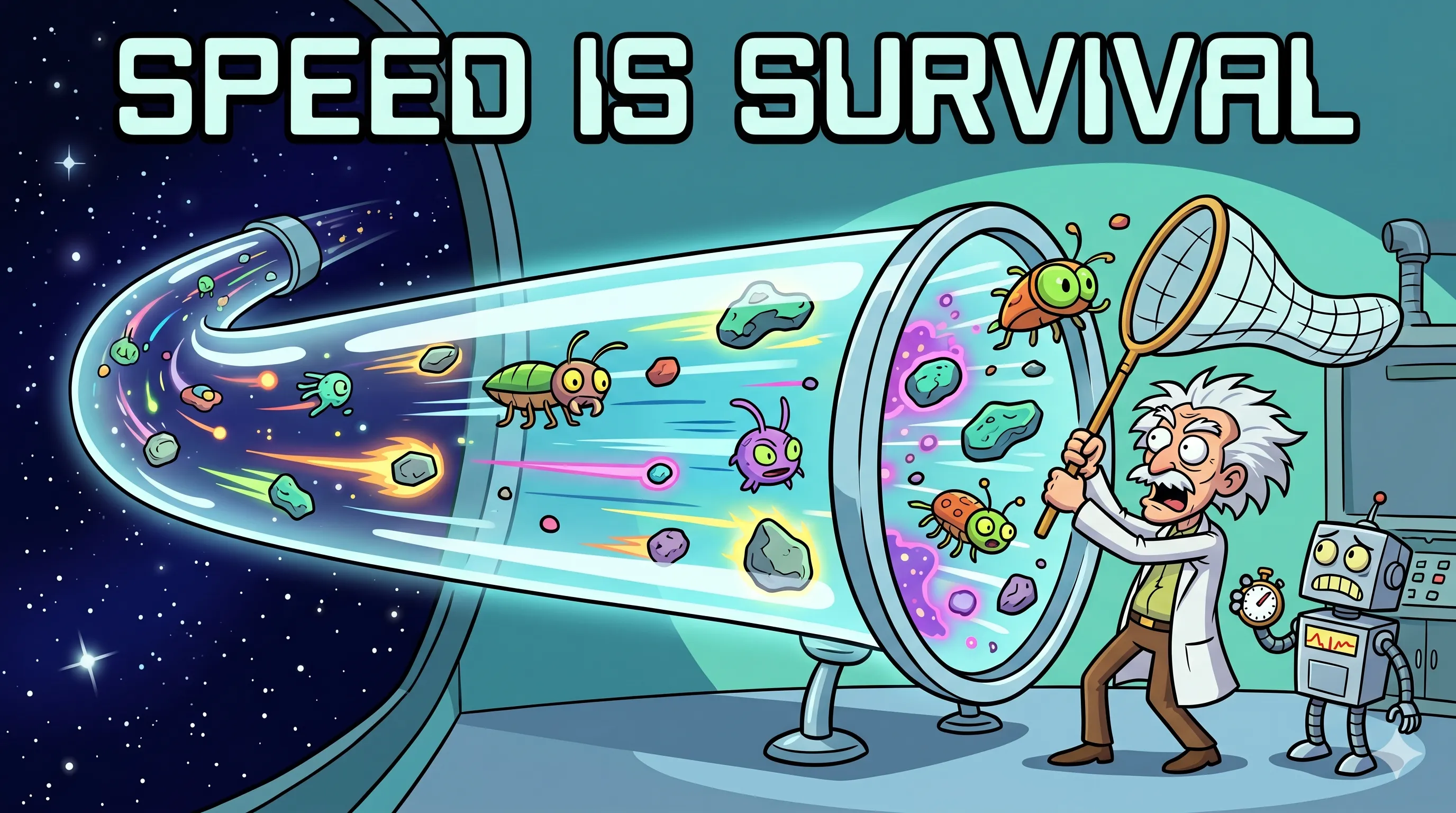
The ship is flying. The warning lights are flashing. The universe has changed, and your engine is getting confused by new types of cosmic dust. You know what you have to do: update the engine.
But how long will that take?
Welcome to Warp Speed.
The Scenario
If it takes you six months to send a drone out to the ship, collect the new cosmic dust, bring it back to the hangar, feed it into the simulator, train a new engine, and install it… your delivery company is already bankrupt.
You don’t need a faster engine. You need a faster hyper-tube connecting the ship to the lab. The moment the ship encounters something weird, it should instantly vacuum that data back to HQ so the scientist can figure it out.
The Reality
In Deep Learning, this is known as Data Velocity or the Data Flywheel.
Many teams focus entirely on building the smartest possible algorithm. But in production, the smartest algorithm usually loses to the fastest data pipeline. When your deployed model makes a mistake, how quickly can you capture that mistake, label it, add it to your training set, and deploy an updated model?
If your team can complete the cycle (collect -> train -> deploy) in one day, while your competitor takes one month, your AI will inevitably become superior.
The Why
Machine Learning is not a logic problem; it is an adaptation problem. The real world produces edge cases at an incredible speed. The only way to survive is to adapt just as quickly. The infrastructure that moves data from production back into your training sets is often more important than the neural network architecture itself.
The Takeaway
Don’t just optimize the AI. Optimize the pipeline that feeds the AI. The team that learns the fastest wins.
AI specialists call it: Data Flywheel & Pipeline Velocity This refers to the automated, high-speed infrastructure that captures production data, especially edge cases or failures, and feeds it back into the continuous training pipeline to iteratively improve the model.
💬 What is a bottleneck in your current workflow that slows down your ability to learn from mistakes?
Part 11 (Speed of Data) of 20 | #DLLifecycleForHumans #ai_edu Based on CS230 Stanford lectures