The Zoom Lens: From Nuts and Bolts to Submarines
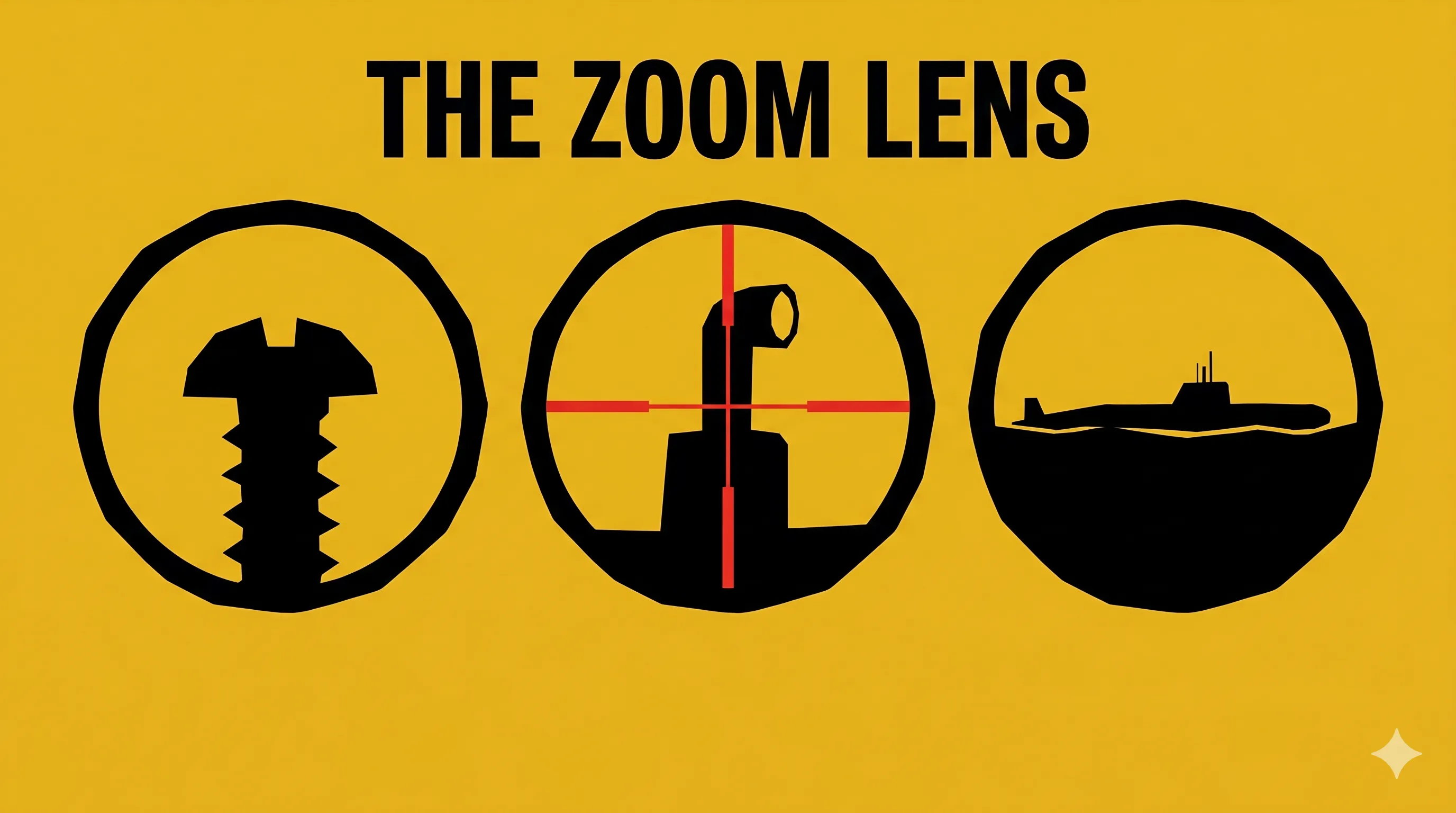
A master spy doesn’t just see a “ship”—they see the specific rivet patterns that reveal which factory built it. Intelligence is built from the bottom up.
The Scenario
Imagine you are an analyst peering through a high-powered, multi-lens telescope at a distant shipyard.
At the first lens (The Lower Layers), your field of view is so tight you only see tiny, meaningless details: a single screw, a jagged metal edge, a splash of grey paint. You can’t tell what you’re looking at yet.
As you click to the next lens (The Middle Layers), you zoom out. Those edges and screws start to form recognizable shapes: a hatch, a periscope, a propeller. Now you have clues.
Finally, you click to the widest lens (The Upper Layers). All those components snap together into a single, terrifying realization: that’s not just a ship; it’s a Project 705 Lira nuclear submarine. This progression from tiny details to complex objects is what we call a FEATURE HIERARCHY.
The Reality
Neural networks don’t “understand” a face or a car all at once. They build that understanding in stages.
The first layers of neurons are experts at spotting simple “features” like horizontal lines or color gradients. They pass these to the next layers, which combine those lines into “higher-level” features like circles or squares. The final layers combine those shapes into complex objects like eyes, noses, or entire human faces.
The Why
This hierarchy is why AI can be so robust—and so easily fooled. If you change a few “low-level” pixels (adding digital noise), you might break the chain, and the AI will fail to “zoom out” correctly, seeing a toaster where there is a person. Understanding that AI sees the world as a stack of parts helps us build better, more reliable systems.
The Takeaway
AI doesn’t see objects; it sees a hierarchy of parts that gradually assemble into a whole.
AI specialists call it: Feature Hierarchy / Representation Learning Feature hierarchy refers to the way deep learning models learn to represent data in increasingly abstract levels. Lower layers detect simple features (edges), while higher layers compose these into complex concepts (objects).
💬 If you were looking at a redacted document, would you focus on the individual letters or the shape of the paragraphs?
Part 12 (Feature Hierarchy) of 25 | #DeepLearningForHumans