Can AI Grade Its Own Homework?
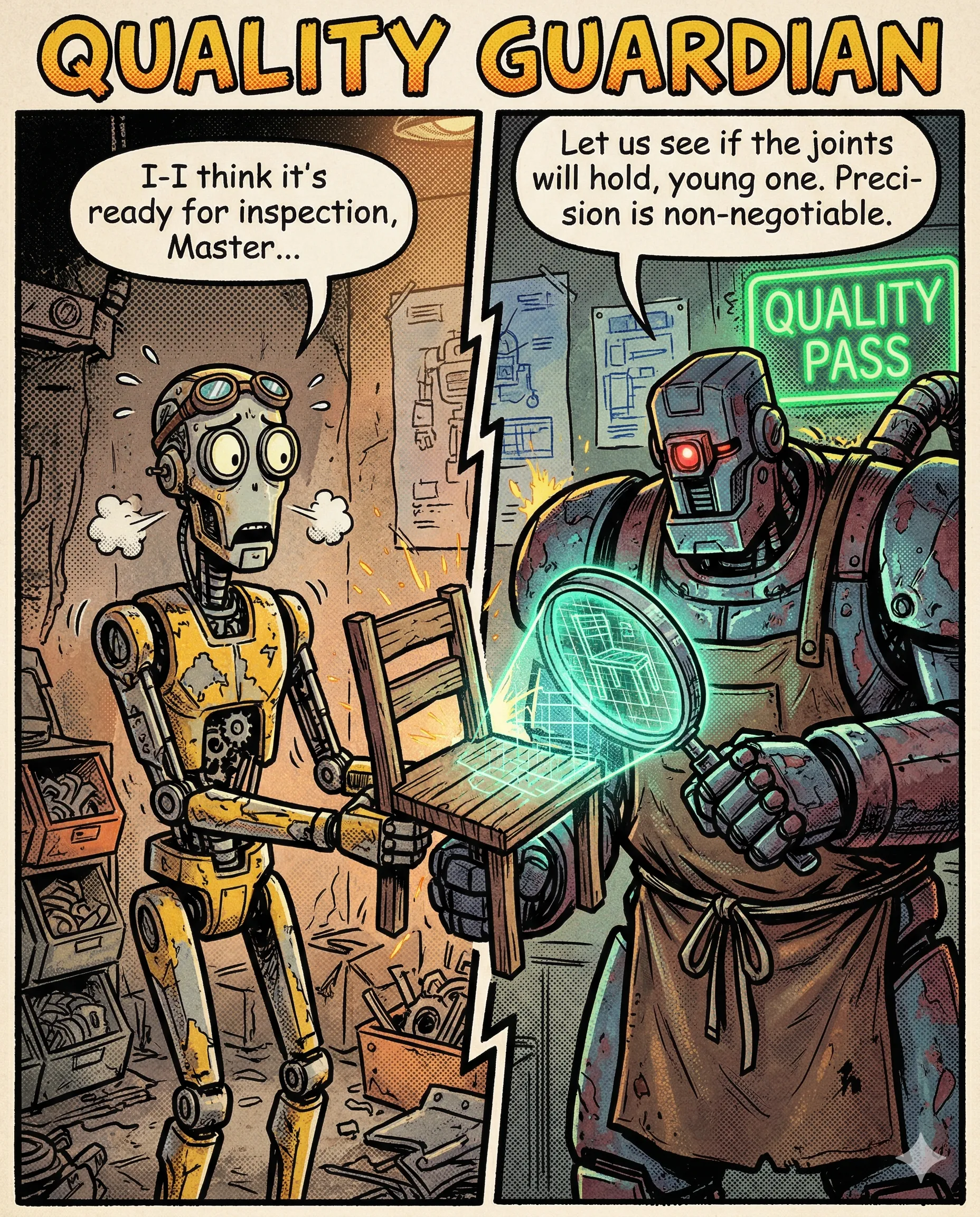
Imagine you are running a high-end furniture workshop. Your apprentice builds a chair, and you, as the master craftsman, inspect every joint and measurement to ensure it meets the highest standards. You have a checklist for stability, smoothness, and design. Because you have years of experience, you can instantly spot a tiny flaw the apprentice might miss.
This process of expert oversight is now becoming automated within the world of AI.
When you build a system that generates answers, you need a way to know if those answers are actually good. Testing thousands of responses by hand is a massive task. To solve this, we use an “LLM Judge”—a more powerful, smarter AI model that acts as the supervisor for a smaller assistant model. The judge reads the generated text and scores it based on your specific rules for accuracy, tone, and helpfulness.
The mechanism behind this is called “LLM-as-a-Judge.” Instead of simple math, we provide the judge with a “Rubric”—a detailed set of instructions on what an ideal answer looks like. The judge model compares the apprentice’s work to this rubric and provides a numerical score or a detailed critique. This creates a “Self-Improving Loop” where the system identifies its own weaknesses and adapts until the quality remains perfect.
In practice, this allows you to launch AI products with total certainty. For example, a customer service AI drafts a response to a shipping inquiry. Before the customer sees it, an “LLM Judge” quickly checks if the AI mentioned the correct delivery date and used a friendly tone. If the score is high, the message goes out. If it is low, the system flags it for a quick human check. The “Quality Guardian” keeps your brand voice consistent every single time.
Success happens when the standard for quality becomes part of the system itself. You transition from “hoping it works” to “knowing it’s right.”
The Takeaway: a great AI system works like a workshop, with one model to create and a smarter model to verify.
Why This Matters for Your AI Product
Automated evaluation is the secret to scaling AI beyond a fun prototype:
- Consistency at Scale: Manual testing is impossible as your user base grows. LLM Judges provide a consistent quality gate for every single user interaction.
- Continuous Improvement: By logging scores from your judge, you can identify exactly which edge cases your model struggles with and retrain or tune it specifically for those gaps.
- Cost-Effective Testing: Using a high-end model (like GPT-4o) as a judge for a cheaper, faster model (like Llama 3) gives you premium quality results at a fraction of the price.
AI specialists call it: LLM Judges A method of using a high-performance language model to evaluate the quality and correctness of outputs from other AI systems.
If you had to set one “Golden Rule” for an AI judge to check in your business emails, what would it be?
Part 14 of 18 | #RAGforHumans