Complexity: The Sledgehammer Trap
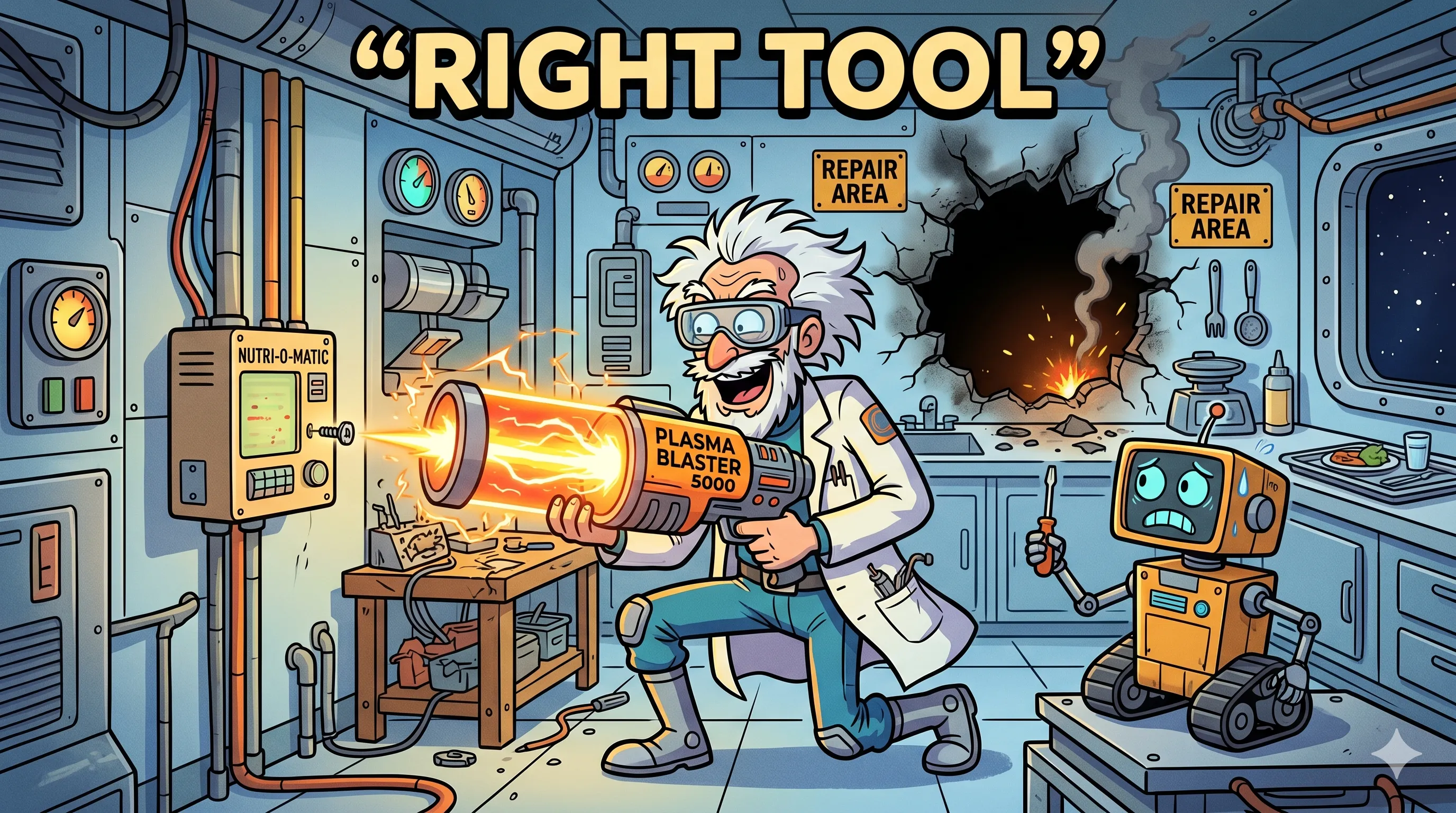
Your chief mechanic is standing in the middle of the spaceship galley, proudly holding a 10-ton industrial plasma demolition cannon. He just used it to tighten a single, tiny screw on the food synthesizer door. The screw is tight, but the synthesizer is now a puddle of molten metal, and there’s a smoking hole in the hull.
He solved the problem. He also destroyed the ship.
The Scenario
When developers first get access to massive, state-of-the-art neural networks, they want to use them for everything. They take a model designed to generate cinematic videos and try to use it to classify three types of support emails.
This is the Sledgehammer Trap. If your model is too complex for the problem you are solving, it won’t generalize. It will memorize your tiny dataset perfectly — noise and all — and fail completely when it meets a real customer.
The Reality
In deep learning, this is the classic battle between Underfitting (High Bias) and Overfitting (High Variance).
If your model is too simple — like trying to break open an armored vault door with a pocket screwdriver — it will underfit. It doesn’t have the capacity to learn the pattern. You solve this by making the model larger, training it longer, or using a more complex architecture.
But if your model is too complex — like using that plasma cannon on a tiny screw — it will overfit. It has so much capacity that it memorizes the exact placement of every dust particle in your training images. The moment you show it a clean image, it gets confused.
You solve overfitting not by adding more code, but by simplifying. Reduce the model size. Add regularization (like dropout, which randomly switches off neurons during training so the network can’t rely on any single path). Or — best of all — gather more training data to force the model to learn the general rule instead of memorizing shortcuts.
The Why
Matching model complexity to your data size and problem complexity is the core skill of AI engineering. A smaller model is faster, cheaper, easier to maintain, and often performs better in the real world than a bloated, over-parameterized giant.
The Takeaway
Choose the right tool for the job. If a screwdriver can solve the problem, put the plasma cannon away. Complexity is not a feature; it’s a liability.
AI specialists call it: Bias vs. Variance & Model Capacity Underfitting (high bias) occurs when a model lacks the capacity to capture the underlying pattern. Overfitting (high variance) occurs when a model is too complex relative to the dataset, leading it to memorize noise. Balancing capacity involves adjusting model size, training time, regularization, and dataset size.
💬 What’s a time you built an overly complex solution for a simple problem, only to realize later a basic spreadsheet or rule would have worked?
Part 17 (Complexity) of 20 | #DLLifecycleForHumans #ai_edu Based on CS230 Stanford lectures