The Three-Agent Drill: Pulling Close, Pushing Away
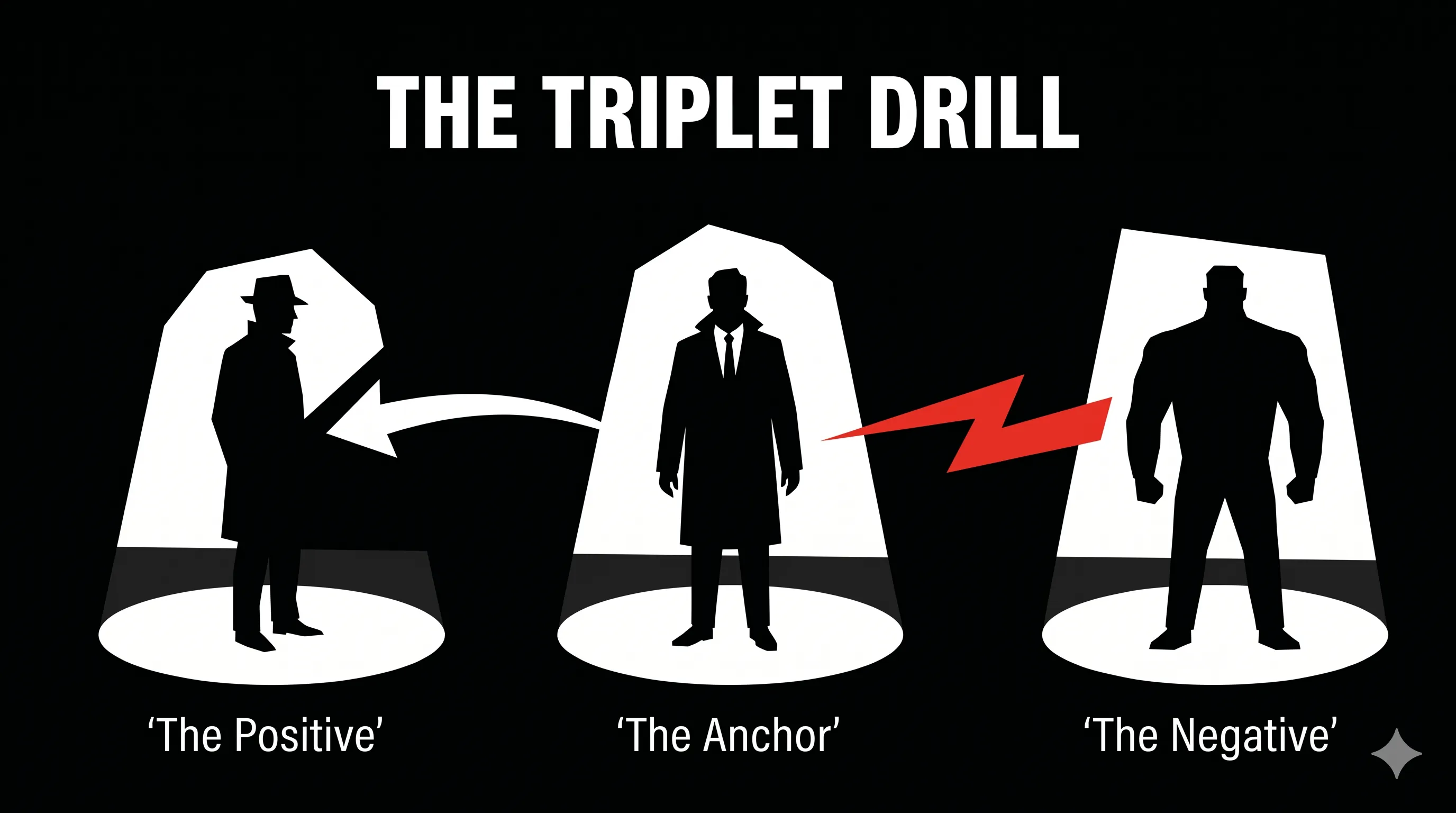
In the field, recognition is a game of millimeters. To train a master operative, you don’t just show them the target—you force them to compare.
The Scenario
Imagine a high-intensity drill in a dimly lit interrogation room. You are the instructor, and you have three agents standing before you.
- The Anchor: This is the target we are studying. Let’s say it’s a photo of Agent Smith.
- The Positive: This is another photo of Agent Smith, but wearing sunglasses and a hat. He is the same person, but he looks different.
- The Negative: This is a photo of a completely different person who happens to have a similar jawline.
The drill is simple but brutal: Your brain must learn to pull the Positive closer to the Anchor (recognize they are the same) while simultaneously pushing the Negative as far away as possible. If the distance to the enemy is smaller than the distance to the friend, you fail the drill. This constant adjustment of “mental distance” is what we call TRIPLET LOSS.
The Reality
In Deep Learning, especially in face recognition or image search, we use a mathematical technique called Triplet Loss.
The model is shown three examples at once: an Anchor, a Positive, and a Negative. The “Loss Function” (the machine’s sense of regret) calculates the distances in the embedding space. It rewards the model when the Positive is close to the Anchor and punishes it when the Negative is too near. This forces the neural network to create a map where similar things are tightly clustered and different things are widely separated.
The Why
Standard classification (is this a cat or a dog?) isn’t enough when you need to distinguish between thousands of unique individuals. Triplet Loss allows the AI to learn relative similarity. It learns the “essence” of an identity by constantly comparing it to what it is and what it is not. This is the technology that allows your phone to recognize your face even when you grow a beard or put on glasses.
The Takeaway
Triplet Loss is the drill that teaches AI to keep friends close and enemies at a safe distance in its mental map.
AI specialists call it: Triplet Loss / Contrastive Learning Triplet loss is a loss function where a baseline (anchor) input is compared to a positive (truthy) input and a negative (falsy) input. The goal is to minimize the distance between the anchor and the positive, and maximize the distance between the anchor and the negative.
💬 If you had to pick an “Anchor” for your best friend, what would be the hardest “Negative” for an AI to distinguish?
Part 19 (Triplet Loss) of 25 | #DeepLearningForHumans