The Silent Alliance: Uncovering Secret Networks
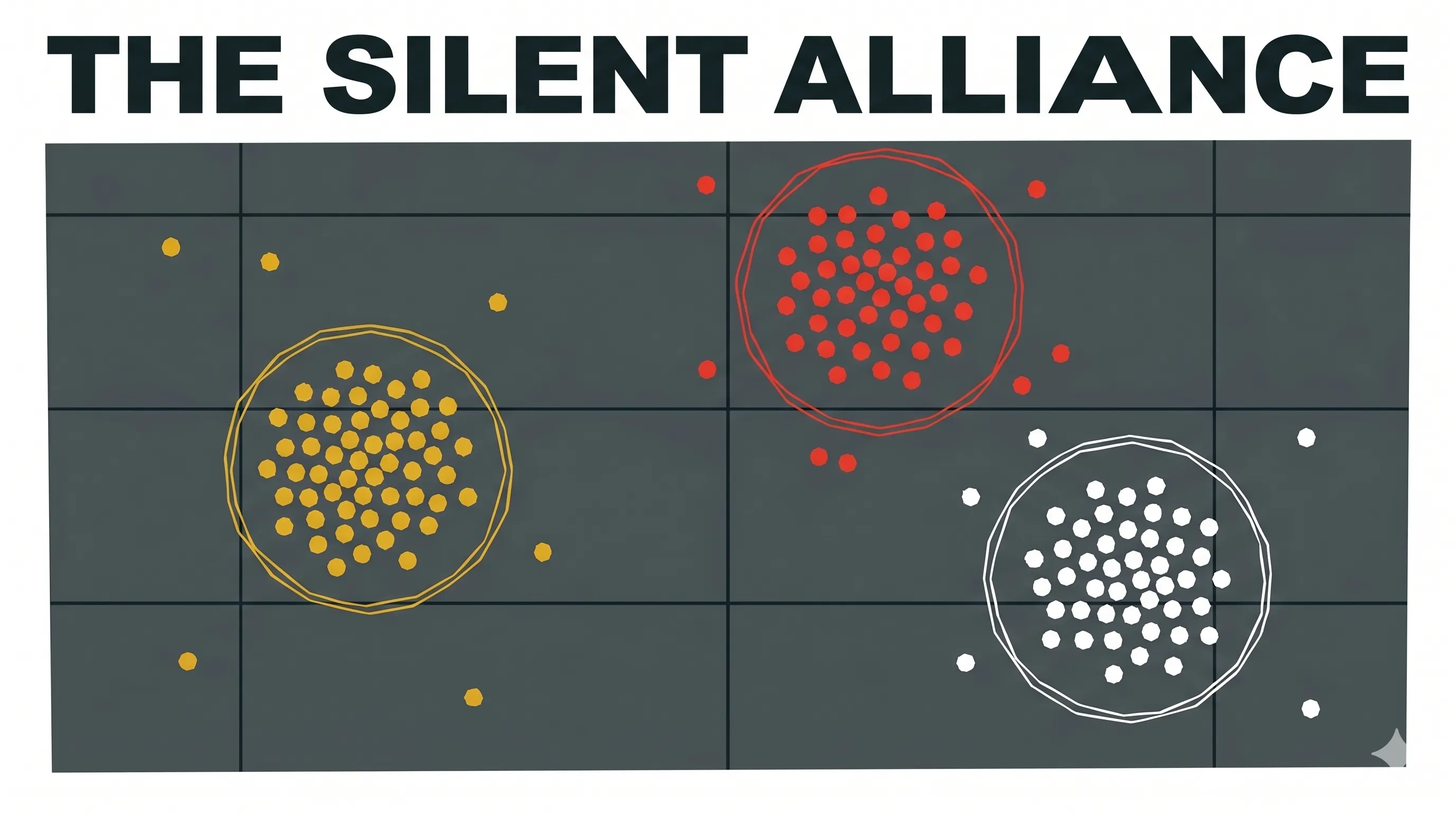
In the field, the most dangerous enemies are the ones who never meet in public. They don’t wear uniforms, and they don’t have a central headquarters. But they leave a trail.
The Scenario
Imagine you are an analyst intercepted a mountain of encrypted metadata from a city’s communication grid. You have no names, no labels, and no “Ground Truth” (Post 18). To any other agent, this looks like a random pile of digital noise.
But you don’t look for labels. You look for PATTERNS.
You plot every communication event on a massive coordinate system. After a few minutes, the noise begins to shift. Three distinct “bubbles” start to form:
- Cluster A: A group of 50 numbers that only communicate between 3:00 AM and 4:00 AM.
- Cluster B: A group that only uses short, high-frequency bursts of data from the docklands.
- Cluster C: A network that communicates across the city, but only through a specific proxy server in Zurich.
You didn’t tell the machine what to look for. You just asked it: “Who is standing close to each other?” This is CLUSTERING. You have discovered three secret alliances that nobody knew existed, simply by grouping things that share a similar “vibe.”
The Reality
Clustering is a core part of Unsupervised Learning. Unlike the “Teacher” models we discussed before, clustering algorithms don’t have an answer key. They look at raw, unlabeled data and group it based on mathematical similarity.
The most common method is K-Means Clustering, where the algorithm tries to find the center (the “heart”) of a group and pulls all similar points toward it. It’s used for everything from segmenting customers into personality types to detecting unusual patterns in bank transactions that might signal a hack.
The Why
Clustering is the “Detective” of AI. It finds the things you didn’t even know you were looking for. It uncovers the hidden structure of the world—the secret alliances between products, the silent networks of fraud, and the unexpected groupings of human behavior. It doesn’t need to be told the truth; it discovers it.
The Takeaway
Clustering is the art of finding hidden relationships in raw data by grouping things that behave in the same way.
AI specialists call it: Clustering / Unsupervised Learning Clustering is the task of grouping a set of objects in such a way that objects in the same group (called a cluster) are more similar to each other than to those in other groups.
💬 If an AI clustered all your daily habits, what would be the most “mysterious” group it would find?
Part 22 (Clustering) of 25 | #DeepLearningForHumans