The Autodidact: Filling in the Blanks
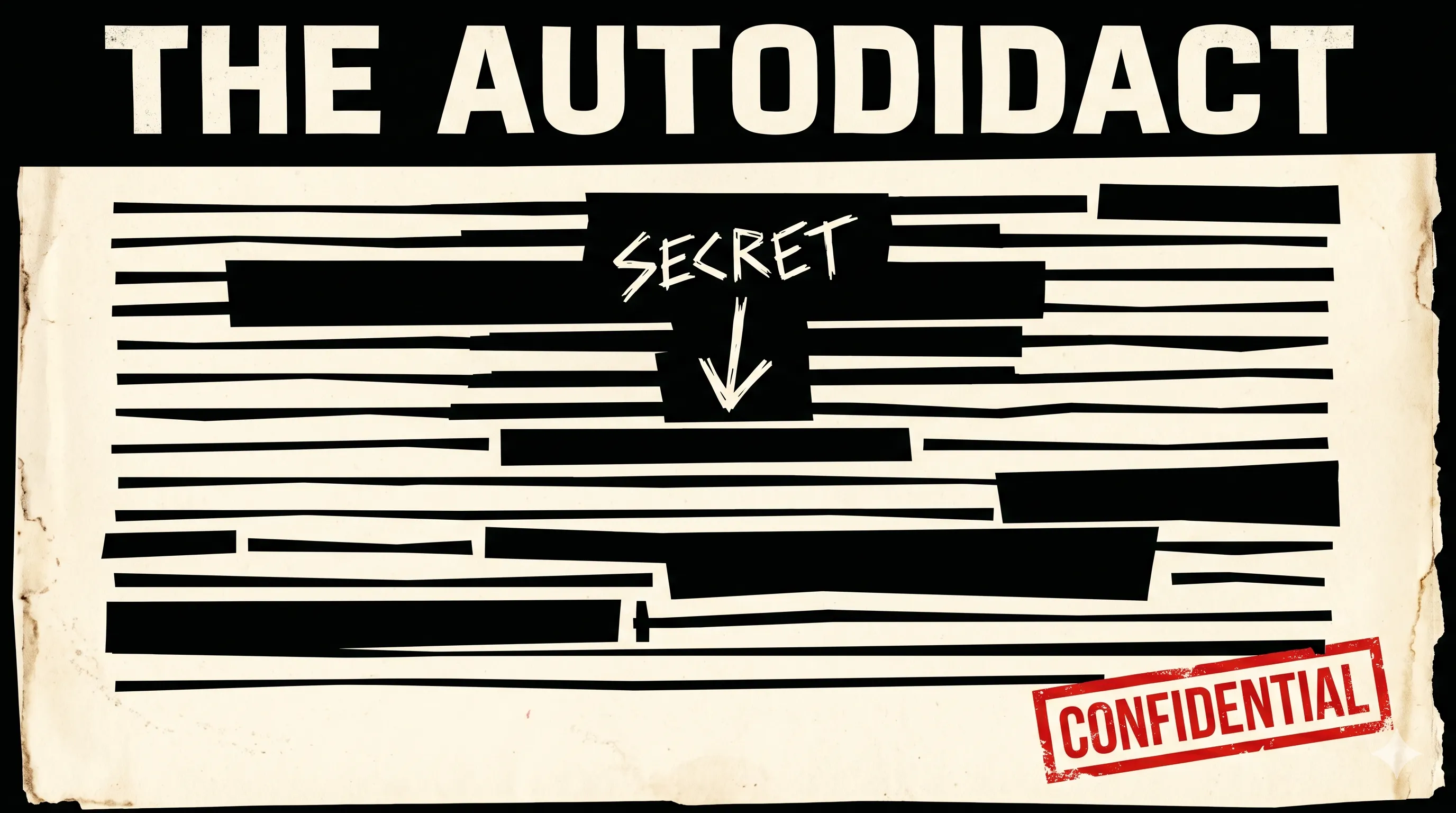
In the highest levels of the agency, there are no instructors. There is only a mountain of raw data and the silence of the archives. To become a master, you must teach yourself.
The Scenario
Imagine you are a specialized analyst locked in a high-security library. You are given ten thousand “Redacted” documents—sentences where every fifth word is covered by a thick black bar.
You have no dictionary, no teacher, and no labels. You simply start reading.
- “The asset was [REDACTED] in East Berlin.”
- “The drop-off happened at [REDACTED] tonight.”
You start to guess. For the first sentence, you guess “spotted.” For the second, you guess “midnight.” Then, you peel back the black bar to see the truth. If you were right, your mental model of the world grows stronger. If you were wrong, you adjust your internal logic.
By doing this ten million times, you have taught yourself the grammar of espionage, the timing of operations, and the geography of the field—all without a single lesson. You have become an AUTODIDACT. This is SELF-SUPERVISED LEARNING.
The Reality
Self-supervised Learning is the secret sauce behind modern Large Language Models (like GPT) and advanced image recognition. Instead of requiring humans to manually label data (Post 18), the model uses the data itself as the teacher.
It hides parts of the input (a word in a sentence, a patch of an image) and tries to predict what is missing. The “Truth” is already there in the data—the model just has to find it. This allows AI to train on the entire internet, learning the deep structure of human language and the physical laws of images without a single human “labeler” in the loop.
The Why
Self-supervised learning is the path to scale. Humans can only label so many photos, but the internet has billions. By teaching the machine to “fill in the blanks,” we allow it to learn at a speed and volume that would be impossible with traditional teaching. It is the transition from a student following a textbook to a master who understands the underlying patterns of reality.
The Takeaway
Self-supervised learning is the art of teaching AI to use raw data as its own instructor by predicting hidden parts of that data.
AI specialists call it: Self-Supervised Learning Self-supervised learning is a form of machine learning where the data provides the supervision. The model is trained to predict part of the input from other parts of the input (e.g., predicting the next word in a sentence).
💬 If you had to “redact” one habit from your daily routine, would an AI be able to predict exactly what you were doing based on the rest of your day?
Part 24 (Self-supervised Learning) of 25 | #DeepLearningForHumans