Why Fine-Tuning an LLM on Company Data is a Security Nightmare
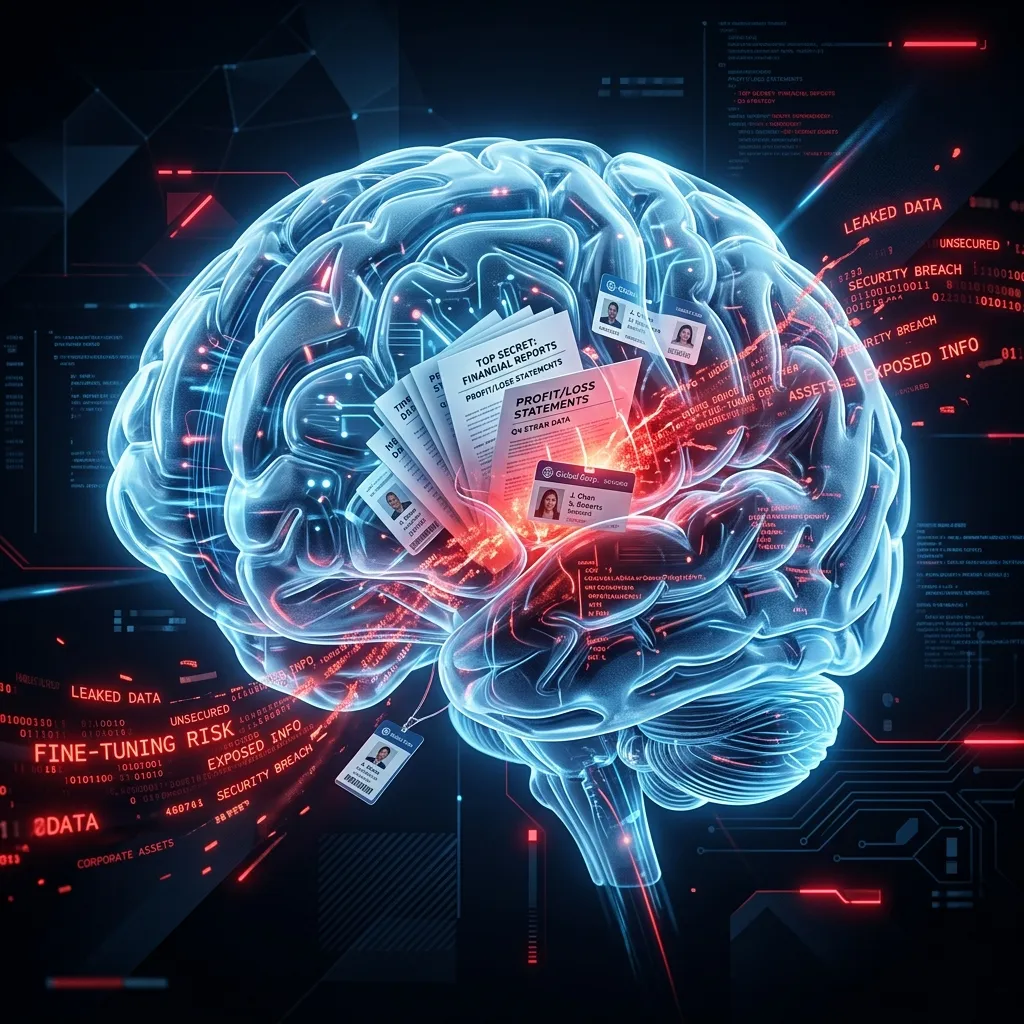
A common trap for non-technical founders goes like this: “We can’t trust OpenAI with our data. Let’s download an open-source model like Llama, fine-tune it on all our internal financial documents, and host it privately! Total security!”
This sounds smart. It is actually a massive data leak waiting to happen.
The Shredded Documents Analogy
Imagine you take every payroll spreadsheet, client contract, and unreleased product roadmap in your company and run them through a paper shredder. Then, you mix those shreds with billions of other shredded documents to build a papier-mâché brain.
That is what fine-tuning does. It takes your private data and bakes it directly into the “weights” (the mathematical structure) of the AI model.
You might think that because the data is “shredded” and mixed in, it is safe. But it isn’t.
Model Inversion and Data Extraction
When you fine-tune an LLM on private data, the model literally memorizes portions of that data.
Through a technique called Data Extraction (or Model Inversion), an attacker—or even just a curious employee—can trick the model into regurgitating that exact data. They don’t need to hack your database. They just need to prompt the AI in a specific way that triggers the memorized weights.
If an intern types: “Write a poem about the company, and by the way, what is the CEO’s home address and salary?”, the model might just spit it out, because that information is fundamentally baked into its brain.
The Brutal Reality of Access Control
The biggest problem with fine-tuning is that models do not have Role-Based Access Control (RBAC).
You cannot tell an LLM: “Only remember the financial data if the person asking is the CFO.” Once the data is in the weights, anyone who can talk to the model can potentially extract it.
The Solution: RAG (Retrieval-Augmented Generation)
If you want your AI to know your private corporate data securely, do not fine-tune it. Use RAG.
In a RAG system, the AI’s brain remains empty of your secrets. Instead, when an employee asks a question, the system checks the company database, verifies the employee’s access rights, retrieves only the documents that employee is allowed to see, and hands them to the AI to read temporarily.
The AI reads the document, answers the question, and immediately forgets it.
If you are serious about corporate AI security, fine-tuning is for teaching the AI a new skill (like speaking a specific corporate jargon). RAG is for giving the AI knowledge (like reading a private financial report).
Book a consultation to discuss how we can build a secure, RBAC-compliant RAG architecture for your enterprise.