The Phantom Inventory: The Assets Nobody Tracks
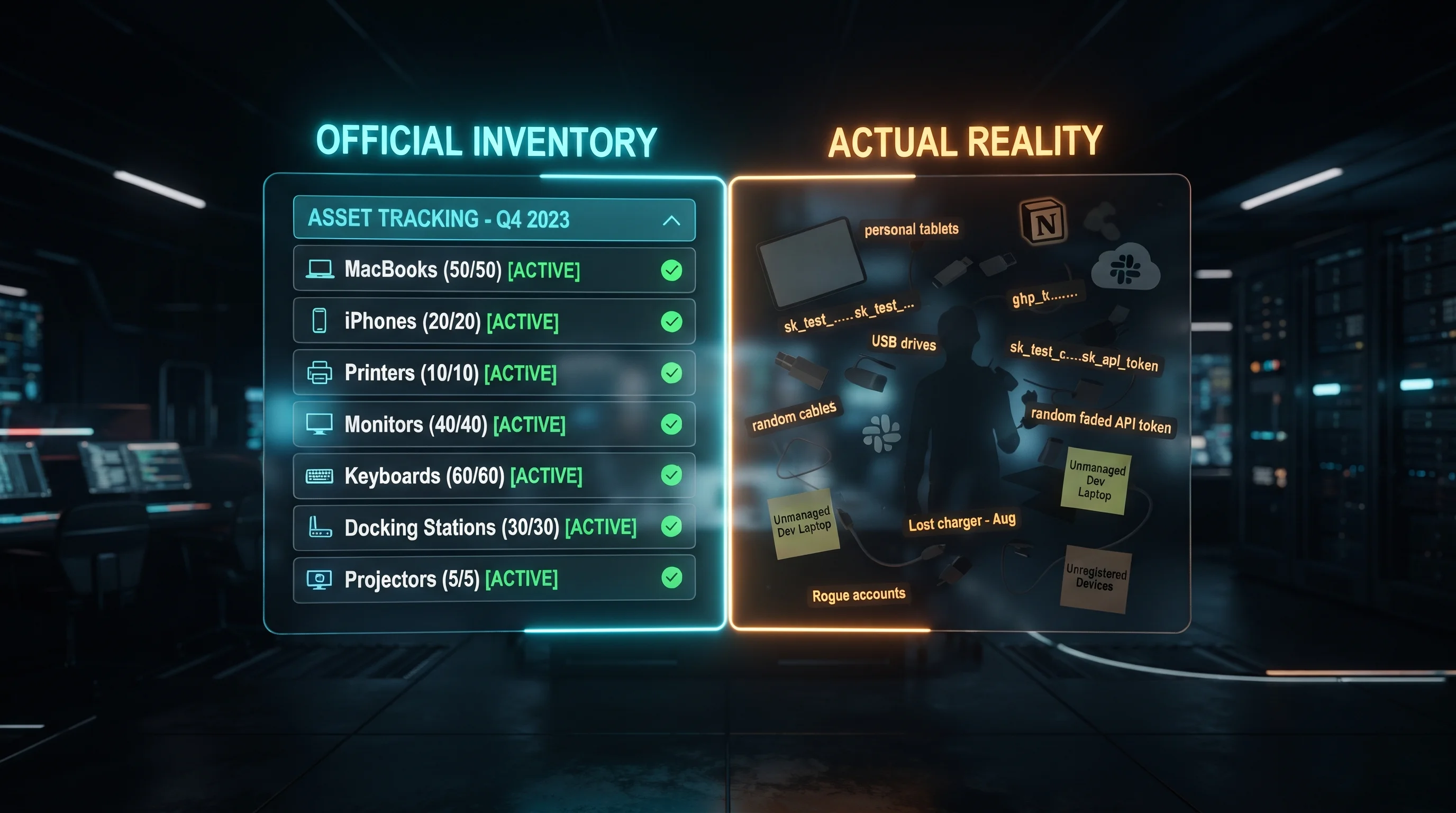
Your IT spreadsheet says 50 MacBooks. But Ahmed in sales has been using a personal iPad for client emails since the pandemic. Zara from the marketing agency has production Figma access from her home Windows laptop. And the third-party bookkeeping SaaS your finance team onboarded six months ago — nobody logged that anywhere.
ISO 27001 Control 5.9 is called “Inventory of Information and Other Associated Assets.” The requirement is simple: know what you have. Know who owns it. Know where it lives.
The reality inside most companies that go through the certification audit? The spreadsheet passes. The assets it misses are where the actual exposure lives.
The Spreadsheet That Passes the Audit
Here’s what happens. Before an ISO 27001 audit, an IT admin exports every device from the MDM platform (Jamf, Intune, whatever). That list gets formatted into a spreadsheet: device name, serial number, assigned user, OS version, encryption status. The auditor reviews it. It’s clean. Everything checks out.
What the MDM doesn’t see: personal devices. Contractor laptops. Cloud SaaS tools added by team leads without a procurement ticket. Browser extensions that sync work data to personal accounts. API tokens generated by a developer who left the company eight months ago.
The official inventory is a photograph of your living room furniture taken for a fire insurance claim. The basement is full of fireworks, and nobody thought to mention it.
Why Personal Devices Are the Real Exposure
BYOD (bring your own device) policies come in two flavors: the kind you wrote down and the kind that’s actually happening.
The kind that’s actually happening: your team uses personal phones for Slack and work email because MDM enrollment friction is high and nobody enforced it. Your contractors — the designers, the copywriters, the offshore QA team — work from their own machines because issuing corporate hardware for a 3-month engagement is “not worth the hassle.”
Control 5.9 requires that assets processing organizational information appear in the inventory. “Information” includes email threads, internal Figma files, Notion pages with client data, exported CSV reports from your analytics dashboard. All of it.
If a contractor’s personal MacBook holds a Figma project with unreleased product designs, ISO 27001 wants that device in scope. Not necessarily enrolled in MDM — but documented, with a known owner, known data classification, and a defined acceptable use agreement.
Most companies have none of that.
The Invisible SaaS Layer
Personal devices are visible if someone looks. The harder category is shadow SaaS.
A project manager signs up for a time-tracking tool for their team. A developer integrates a third-party API for PDF generation. Marketing pulls in a new analytics SDK that starts sending user behavior data to a US-based server.
None of these go through a procurement review. None appear in the asset register. None trigger a data processing agreement check. And all of them are, legally, sub-processors handling organizational or customer data.
The ISO 27001 scope document says “our asset inventory is complete.” The browser’s network tab on your production checkout page tells a different story — twelve third-party domains, four of which nobody on the security team has heard of.
What a Proper Asset Register Actually Requires
Control 5.9 specifies three things for each asset:
Owner — a named person accountable for the asset, not just a team or department. “IT” is not an owner. “Ahmad Khalil, IT Director” is an owner.
Classification — what kind of information does the asset process or store? Public, internal, confidential, restricted? This matters because the security controls you apply differ by classification.
Lifecycle status — is it active, decommissioned, in procurement, in disposal? A decommissioned laptop that still has a valid Azure AD entry and an active VPN certificate is an active risk dressed as a closed ticket.
The spreadsheet approach breaks for SaaS because SaaS doesn’t have serial numbers. The practical fix is a service catalog: every tool goes through a lightweight intake form before the team signs up. Tool name, owner, data it touches, vendor’s compliance status (SOC 2 or equivalent), and renewal date. Five fields. Takes three minutes. Catches the problem before it’s in scope.
The API Token Problem
Here’s the exposure that asset management programs almost universally miss: credentials and tokens.
When a developer generates an AWS access key, a GitHub personal access token, or a Stripe secret key for a local integration, that credential is an asset. It has access to data, it carries permissions, and it has a lifecycle. If the developer who created it leaves the company, the token doesn’t expire automatically. It just keeps working until someone notices.
ISO 27001 Annex A Control 5.17 covers authentication information separately, but the asset register is where the coverage begins — if credentials aren’t logged as assets, the offboarding checklist doesn’t know to revoke them.
The engineering fix is mechanical: mandate that all long-lived tokens are created under service accounts (not personal developer accounts) and stored in a secrets manager with owner metadata and a mandatory expiration policy. Tools like Infisical, HashiCorp Vault, or AWS Secrets Manager with rotation policies make this operational rather than aspirational.
What Auditors Actually Check
ISO 27001 auditors during Stage 2 certification don’t just review the asset spreadsheet. They cross-reference it.
They ask: pick three people from your engineering team and show me every asset assigned to them. They compare the HR list of active employees against the MDM device list. They ask what happens to assets when someone leaves — show me the last three offboarding cases.
The gap they find, reliably, is the contractor problem. Full-time employees go through offboarding. Contractors often don’t. Their Figma access stays active. Their GitHub invites stay open. Their Notion guest pages remain readable.
The fix requires treating contractor lifecycle the same way as employee lifecycle — not in theory, but in the actual process. Access provisioning tied to contract start date. Access revocation tied to contract end date. Automated, not manual.
The Right Scope for a Starting Team
If you’re a startup going through ISO 27001 for the first time, the asset register doesn’t need to cover every Slack message ever sent. The correct scope is whatever information assets are covered by your Information Security Management System (ISMS) boundary.
Define that boundary narrowly and honestly. If your ISMS scope covers only the production SaaS platform and excludes internal tools, your asset register covers the production environment. This is legitimate — Clause 4.3 specifically allows you to define scope.
What you cannot do is define a narrow scope and then let unsanctioned tools handle data that falls inside it. If your ISMS scope covers customer PII, and your support team uses a personal email forwarding rule to handle customer tickets — that personal email account is in scope whether you wrote it in the register or not.
The question asset management forces you to answer honestly is: where does the data actually go?
Somewhere right now, a contractor with active production access to a system inside your ISMS boundary is using a device that doesn’t appear on any list in your IT department. The asset register says the room is clean. The room has a window that’s been open since March.
What’s the strangest gap you’ve found between what an asset register claimed to cover and what actually processed sensitive data in your environment?