Pixel Optimization: Sculpting the Perfect Disguise
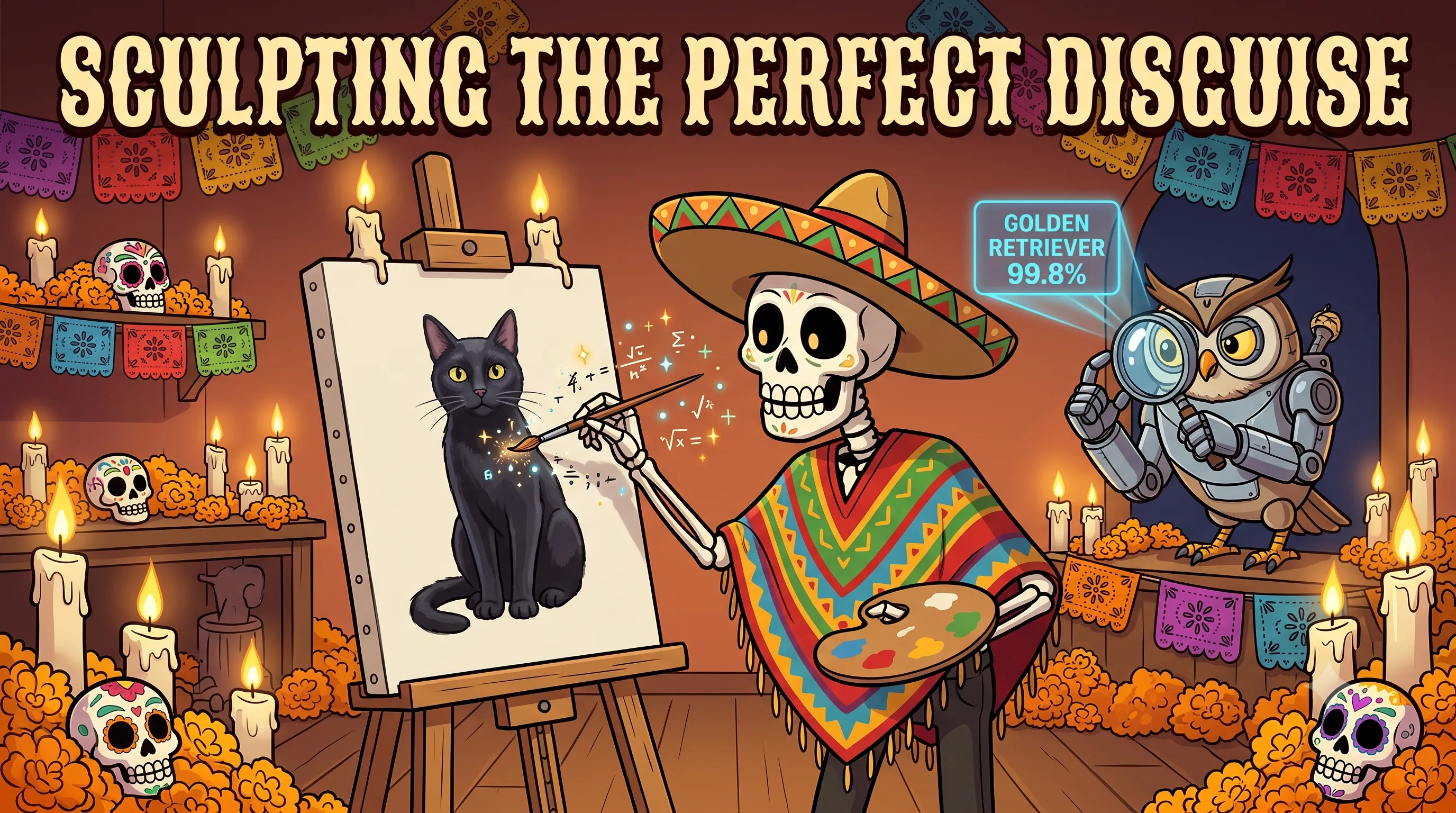
A skeleton artist wants to paint a portrait of a black cat that will trick the cemetery’s robotic guard owl into seeing a golden retriever. A normal painter would try to draw floppy ears. But this artist is a mathematician: she leaves the cat portrait exactly as it is, but uses a tiny single-hair brush to make microscopic adjustments to the paint. She alters the color values of individual canvas fibers by less than one percent. With each tiny brushstroke, she optimizes the paint to maximize the owl’s confusion.
The portrait still looks like a black cat to you. But to the owl, the optimized canvas fibers add up to a perfect golden retriever.
The Scenario
When we train a neural network, we keep the training images fixed and adjust the model’s internal settings (weights) to minimize errors.
But when an attacker wants to hack a model, they do the exact opposite.
The Reality
This is the principle of Pixel Space Optimization (or Input Space Attack).
The attacker freezes the model’s weights so they cannot change. They feed an image into the model and compute the gradient of the loss — but instead of using it to update the model, they use it to update the image’s pixels. They treat the input pixels as parameters that can be optimized using gradient descent. By repeating this loop, the attacker sculpts a custom perturbation that pushes the pixels directly across the model’s decision boundaries.
The Defense
To prevent attackers from mathematically optimizing pixels to fool your vision models, apply these defenses:
- Input Randomization: Randomly resize, crop, or slightly rotate the input image before feeding it to the model. Since the attack was optimized for a specific pixel alignment, any random transformation breaks the alignment and ruins the exploit.
- Pixel Value Quantization: Reduce the color depth of the input image (e.g. from 24-bit color to 8-bit). This rounds off the microscopic pixel adjustments, erasing the precise values calculated by the attacker.
The Takeaway
If you let an attacker optimize the pixels, they can sculpt an invisible mask that makes your model see whatever they want. Never expose your model to raw, unprocessed inputs.
AI specialists call it: Input Space Optimization / Pixel-level Attack In input space optimization, the attacker freezes the model’s weights and uses gradient descent to optimize the input pixels directly to maximize the loss (or target a specific incorrect class). Defenses focus on breaking the precise pixel alignment through input randomization (resizing, cropping) and pixel value quantization.
💬 Have you ever tried to adjust something so minutely to get it “just right” that you ended up making it worse? What was it?
Part 5 (Pixel Space Optimization) of 8 | #AdversarialRobustnessForHumans #ai_edu Based on industry security research