The Simulator: Letting the Machine Fail 10,000 Times
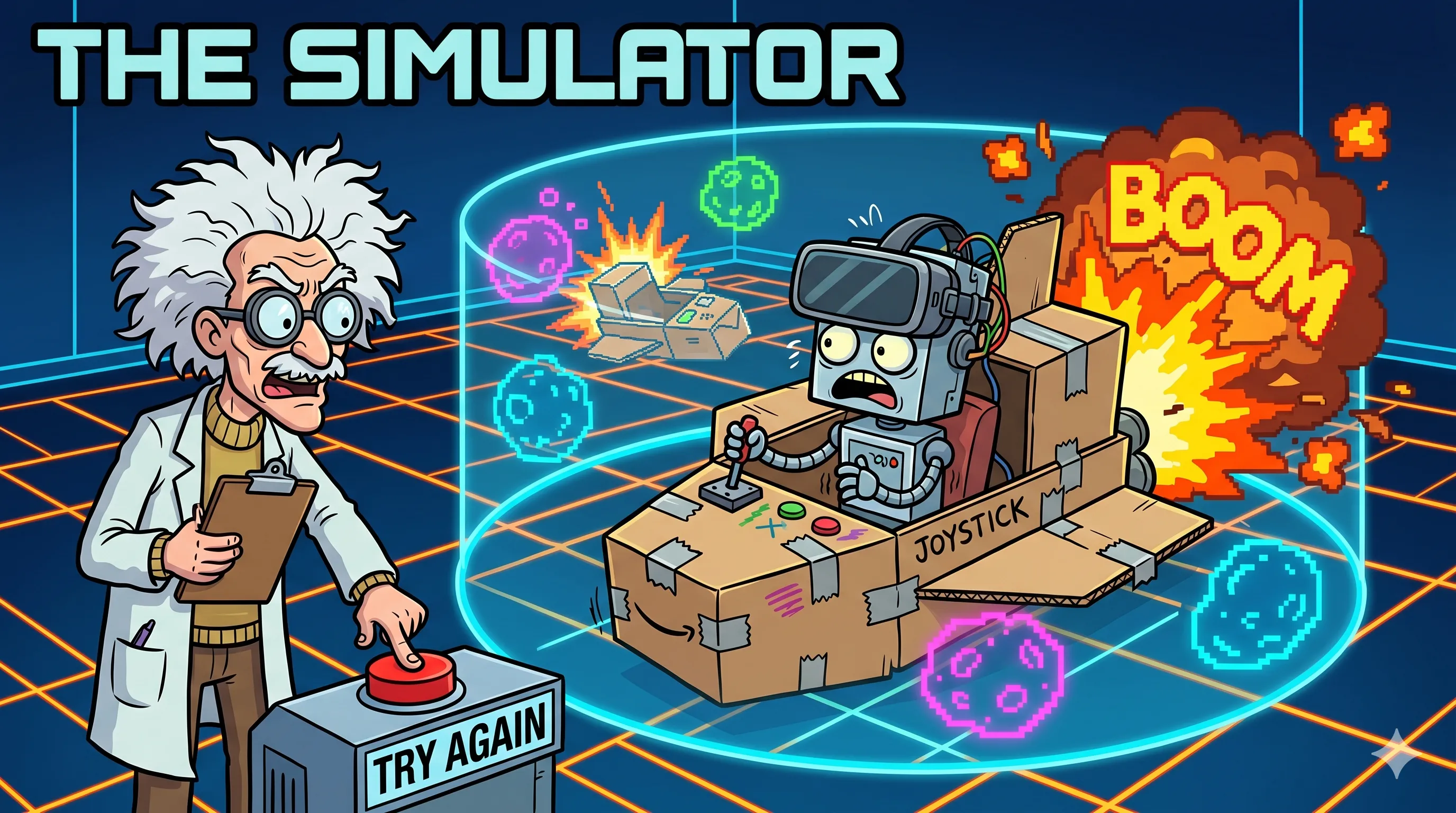
We have our map, our data, and our engine. But we can’t just turn the key and jump to hyperspace. The engine is powerful, but right now, it’s completely stupid. It doesn’t know the difference between a refueling station and a black hole.
So, we put the engine in the Simulator.
The Scenario
We connect the engine to a VR simulation and feed it our data. The engine tries to fly the ship. On its first attempt, it immediately flies into a digital asteroid and explodes.
We tell the engine: “That was bad.” The engine adjusts its internal settings slightly. It tries again. It flies slightly to the left, and then explodes. We tell it: “Still bad.”
In AI development, this brutal, repetitive process of failing, adjusting, and trying again is called Training the Model.
The Reality
Founders often think that “deploying an AI” is like installing software: you click install, wait for the loading bar, and you’re done. Training is nothing like installing. It is more like raising a child in a hyperbolic time chamber.
During training, the model looks at thousands of examples, makes a prediction, checks if it was right, and adjusts its “weights” (its internal math) to be slightly less wrong next time. This requires immense computational power (GPUs) and time. It might take hours. It might take weeks.
The Why
You train the model because an AI doesn’t learn the rules from a programmer writing “If/Then” statements. It learns the rules by experiencing the consequences of being wrong. The better your simulator (the algorithm) and the better your scenarios (the data), the faster the engine learns to avoid the black holes.
The Takeaway
Training an AI is an exercise in managed failure. You aren’t coding the perfect route; you are letting the machine crash 10,000 times so it doesn’t crash on the first real flight.
AI specialists call it: Model Training This is the phase where an algorithm iteratively adjusts its internal parameters (weights and biases) to minimize the error between its predictions and the actual true labels in the training dataset.
💬 If you had to learn your current job by crashing a simulator 10,000 times, what would your most common “fatal error” have been on day one?
Part 7 (Train Model) of 20 | #DLLifecycleForHumans #ai_edu Based on CS230 Stanford lectures