The Time Loop: Living the Same Mistake Until You Survive
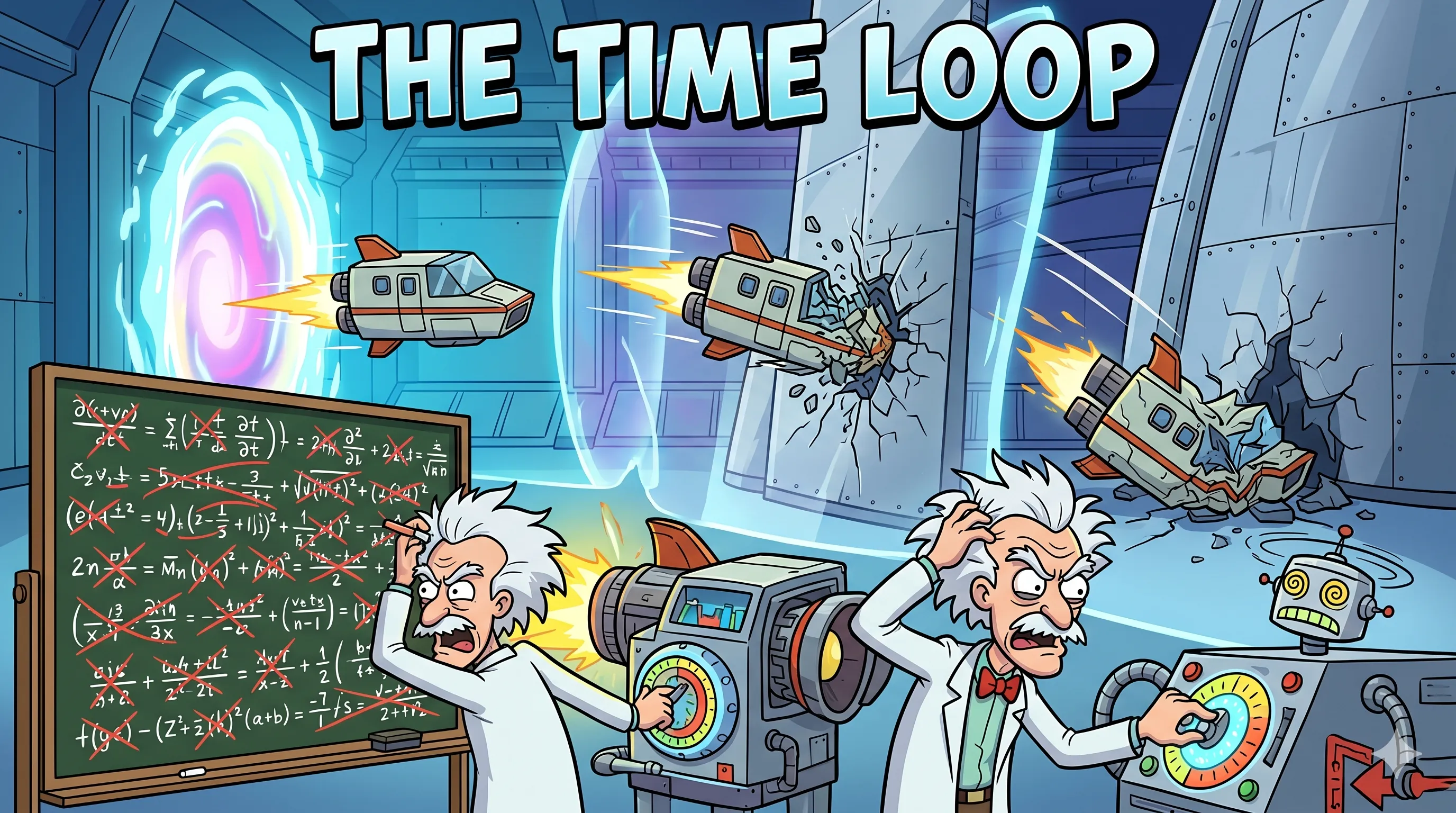
You’ve built the engine. You’ve put it in the simulator. It crashed 10,000 times, learned to dodge the digital asteroids, and finally survived the test run. You pull it out, slap it into the real ship, and take it for a spin.
It immediately flies into a space station.
Welcome to the Time Loop.
The Scenario
You are stuck in a temporal anomaly. Every time the ship crashes, time resets. You are standing back in the hangar, staring at the engine.
You can’t just tell the engine to “be better.” You have to change something about the setup before the next loop begins. Do you need a bigger engine (more capacity)? Did you feed it corrupted fuel (bad data)? Or did the simulator just not include any space stations in its practice runs (poor data coverage)?
You tweak the fuel mixture. You reset the clock. You let the engine train in the simulator again. You test it. Crash. Reset. Tweak the engine size. Train. Test. Crash. Reset.
The Reality
In Deep Learning, this is the Iteration phase.
A model is almost never correct on its first full training run. It might do perfectly on the data you fed it, but fail completely when shown something new (overfitting). Or it might just be terrible at everything (underfitting).
When this happens, you don’t throw the model away. You iterate. You change the hyper-parameters—the dials and switches you set before training began—or you go back and gather different data, and then you train it all over again.
The Why
Machine learning is fundamentally an empirical science. You cannot perfectly calculate the exact architecture and settings your model needs before you build it. You have to run the experiment, observe the failure, form a hypothesis about why it failed, adjust the variables, and run it again.
Speed in AI development isn’t about getting it right the first time. It is about how fast you can complete this loop.
The Takeaway
You will not build the perfect model on day one. Success in AI is determined by how quickly and intelligently you can cycle through the iteration loop.
AI specialists call it: Iterative Machine Learning Process This is the cycle of building a model, training it, analyzing the error metrics (bias and variance), and adjusting hyperparameters, data, or architecture before retraining.
💬 If you were stuck in a time loop at work right now, what is the one task you would finally perfect through sheer repetition?
Part 8 (Iterate) of 20 | #DLLifecycleForHumans #ai_edu Based on CS230 Stanford lectures