Experience Replay: How Shuffling the Past Cures Machine Amnesia
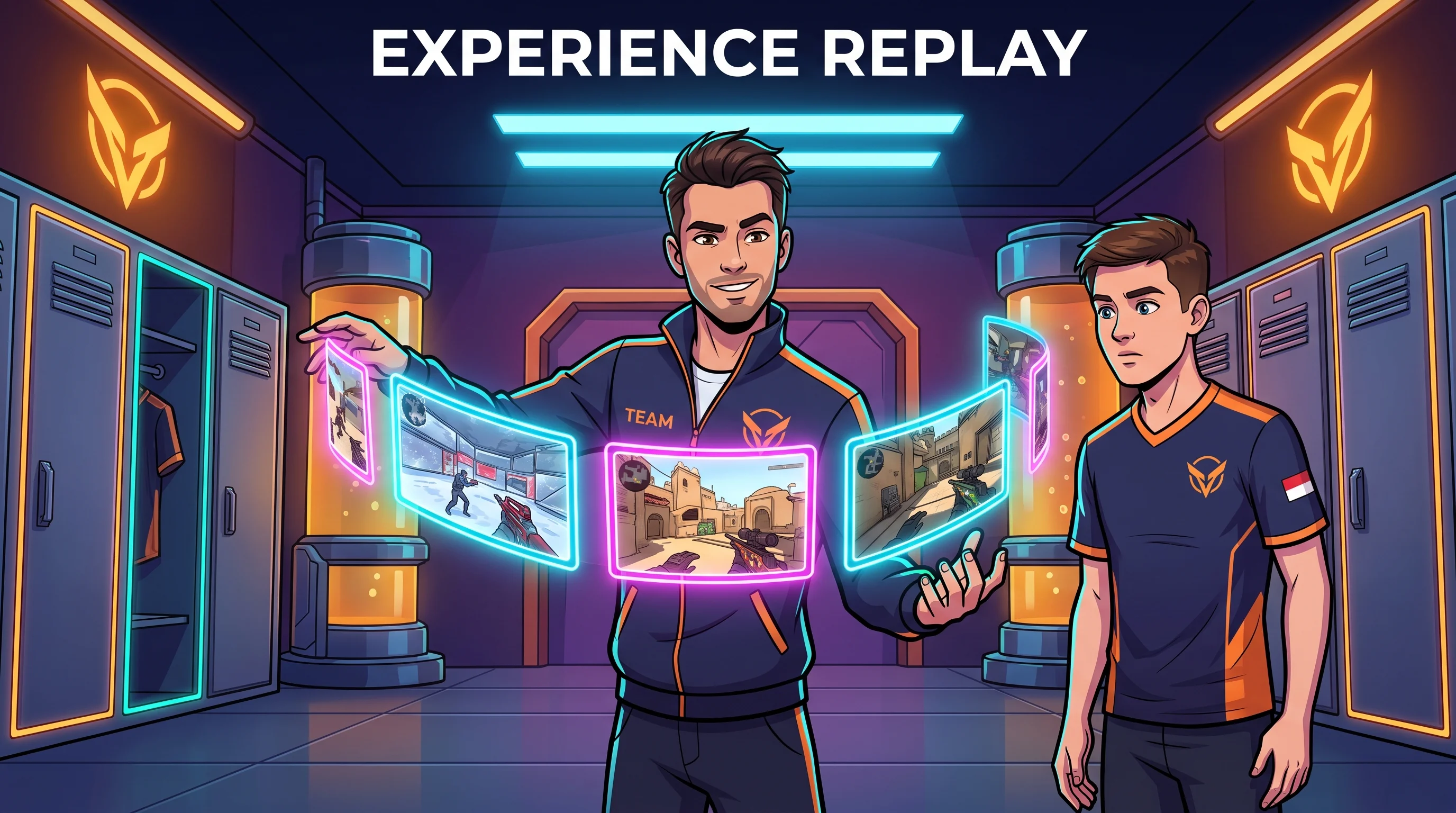
If you spend eight hours practicing only how to defuse a bomb on one specific hallway corner, you will become the undisputed master of that corner.
And the second an opponent attacks you on the opposite side of the map, you will play like you installed the game five minutes ago.
Human athletes call this over-fixation. In machine learning, it is known as Catastrophic Forgetting.
When early deep reinforcement learning agents tried to learn by playing live games, they suffered from a fatal learning flaw: consecutive game frames are virtually identical. Frame 101 looks 99% like Frame 100. If an agent updates its neural network continuously on whatever is happening on screen right this second, it gets trapped in an echo chamber of correlated data. It masters dodging to the left because it spent the last thirty seconds dodging left, completely overwriting everything it learned five minutes earlier about shooting straight.
In traditional machine learning, models require training data to be independent and identically distributed—a principle known as i.i.d.
Live gameplay is the exact opposite of independent. It is a tightly linked chain where every second depends entirely on the second before it.
The Reality
To break this cycle of digital amnesia, DeepMind introduced Experience Replay.
Instead of learning from events the instant they happen and immediately discarding them, the agent records every single interaction into a massive memory bank called a Replay Buffer. Each saved entry contains four simple pieces: the state the agent was in, the action it chose, the reward it received, and the new state it landed in (s, a, r, s').
When it comes time to train the neural network, the system does not look at the last five seconds of play.
Instead, it reaches into the replay buffer like a poker dealer shuffling a deck and pulls out a completely random batch of memories. One memory might be a clutch play from ten minutes ago; another might be a disastrous blunder from yesterday morning; a third might be a boring opening round from last week.
The Why
By shuffling time like a deck of cards, Experience Replay achieves two critical breakthroughs:
First, it shatters temporal correlation. Because the neural network learns from disconnected moments pulled at random from across history, the training data behaves like independent data points again, stabilizing the network’s weights.
Second, it squeezes maximum value out of rare experiences. In gaming, an incredible breakthrough move might only happen once in ten thousand attempts. If you only train on it once live, the network will quickly forget it. By storing it in the replay buffer, the agent can re-sample and learn from that brilliant maneuver dozens of times.
Where does this break down?
A replay buffer is an off-policy method: the memories sitting in the vault were created by older, clumsier versions of the agent. Training heavily on stale memories can slow down learning if the agent’s current strategy has evolved past them. Furthermore, a replay buffer holding a million transitions consumes massive gigabytes of computer memory, and uniform random sampling treats boring, useless moments with the exact same priority as game-winning clutches—a flaw that later required engineers to invent Prioritized Experience Replay.
The Takeaway
To build lasting mastery, do not obsess over your last mistake; shuffle through a wide archive of past lessons so recency bias never blinds you.
AI specialists call it: Experience Replay / Replay Buffer / Off-Policy Learning
Introduced by Lin (1992) and popularized by DeepMind in DQN (Mnih et al., 2013), experience replay stores transitions (s_t, a_t, r_t, s_{t+1}) in a ring buffer. Mini-batches are uniformly sampled to break the temporal autocorrelation between successive state-action pairs and ensure training samples approximate an i.i.d. distribution. Because the stored transitions were generated by historical behavioral policies rather than the current target policy, Experience Replay inherently relies on off-policy algorithms like Q-learning.
💬 Have you ever caught yourself overreacting to a single bad meeting or recent mistake, only to realize you needed to step back and look at your entire year’s performance to see the real pattern?
Part 7 of 15 | #ReinforcementLearningForHumans
#ai_edu Based on Stanford and industry lectures