Why Vegan Food Certification Is the Ultimate Crash-Test for AI
Ask a popular AI chatbot: “What temperature does water boil at on top of Mount Everest?”
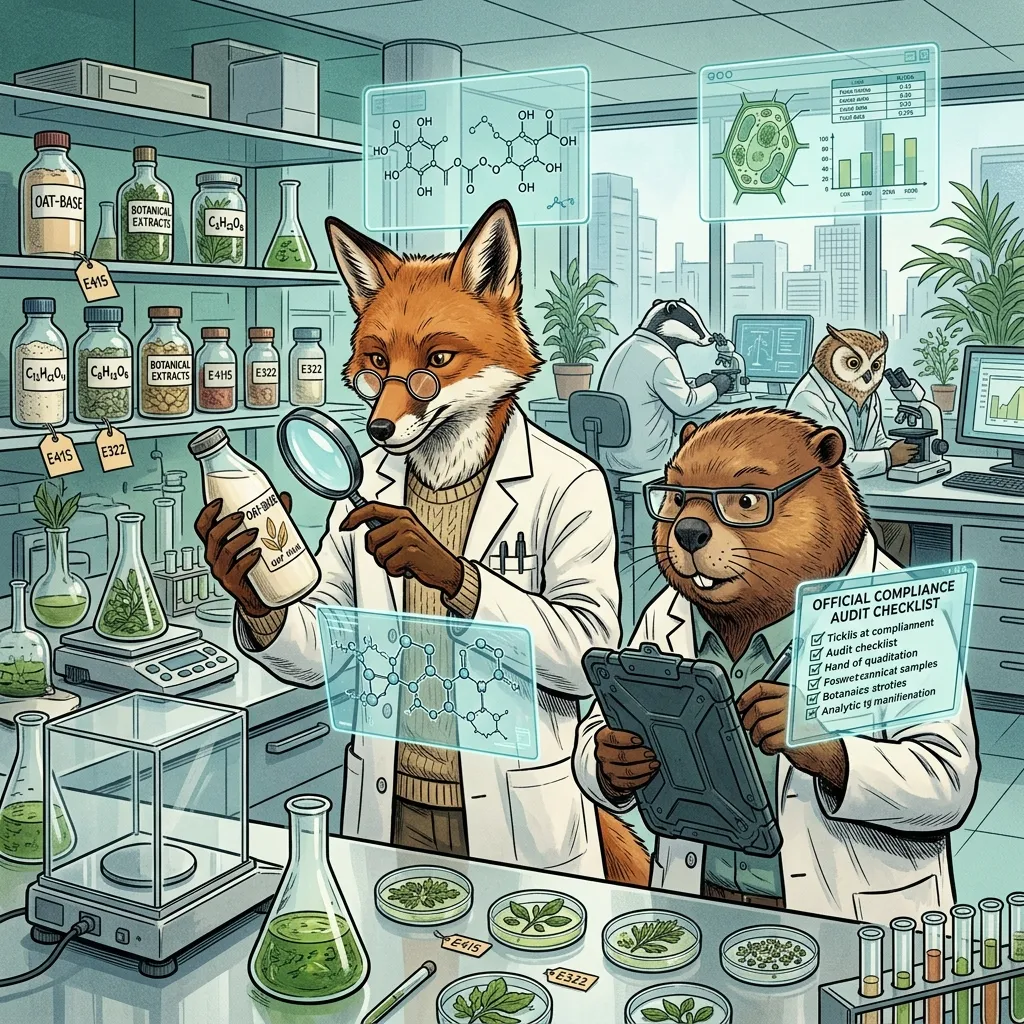
If the model is off by half a degree, nobody gets hurt. But imagine a very different challenge: you are formulating an industrial fortified oat milk or a plant-based burger patty for international supermarket distribution. Before a single carton hits store shelves in Berlin or London, official certification bodies demand a bulletproof compliance dossier for the European V-Label and ISO 23662:2021.
This audit dossier runs anywhere from 300 to 800 pages of dense technical documentation. You cannot tell an auditor: “Well, the sugar is probably plant-based, and we don’t think there is any dairy in the flavor carrier.”
The auditor demands exact chemical origin certificates for emulsifiers, lab ELISA chromatography reports measuring cross-contact proteins down to parts per million (PPM), and signed verification from three tiers of chemical suppliers.
The Regulatory Soup: Three Clashing Worlds
An automated compliance pipeline cannot merely “read” ingredients. It must navigate three fundamentally different rulebooks simultaneously:
- The Technical Global Standard (ISO 23662:2021): The international framework establishing strict definitions for vegetarian and vegan food products, covering processing aids, enzymes, and accidental cross-contact thresholds.
- Commercial Trademark Marks (V-Label & The Vegan Society): Consumer-facing certification bodies with zero-tolerance exclusions. They ban bone-char filtration in sugar, insect-derived food glazes (like shellac E904 or carmine E120), and animal-derived vitamin carriers (such as Vitamin D3 sourced from sheep’s lanolin).
- National Allergen & Labeling Laws (EU 1169/2011 & US FDA): Strict statutory mandates governing factory lines, cleaning validation protocols, and “May contain traces of milk or eggs” allergen declarations.
Why Generic ChatGPT Fails Out of the Box
Most people view large language models as universal brains that “know everything.” In high-stakes regulatory auditing, a standalone conversational model fails almost immediately:
- Hallucinations of Chemical Origins: Large language models are probabilistic text predictors. When an engineer asks whether additive E471 (mono- and diglycerides of fatty acids) in a recipe is vegan, the model politely guesses that it is plant-derived. In reality, E471 can be synthesized from plant oils or slaughtered animal tallow. If the model guesses without inspecting the specific supplier’s batch certificate, the entire submission is rejected.
- Context Collapse and “Lost in the Middle”: You cannot dump fifty supplier Technical Data Sheets (TDS), enzyme safety sheets, and three hundred pages of ISO standards into a single prompt. The model forgets critical sub-clauses buried on page 14 of an obscure vitamin stabilizer datasheet.
- Absence of Ground Truth Lab Data: Models are trained on public internet text. An off-the-shelf LLM has no knowledge of yesterday’s mass spectrometry test showing 0.8 PPM milk protein on packaging Line 3 in a contract facility outside Warsaw.
The Engineering Mission: Deterministic RAG
These failure modes reveal why serious enterprise AI looks nothing like a simple chatbot widget.
In this multi-part Saturday series, we will unpack how to build an industrial Retrieval-Augmented Generation (RAG) architecture designed for rigorous document compliance.
The core philosophy is simple: the neural network is never trusted as a source of truth. It is used strictly as an articulate natural language synthesizer. Every ingredient origin, every chemical CAS number, and every regulatory threshold is deterministically retrieved from verified data stores and enforced by mathematical validators.
Next Saturday, we dive into Chapter 2: The Geometry of Ingredients—how complex food chemistry turns into vectors, and why naive semantic search fails when comparing “contains no animal fats” to “contains animal fats”.
Have you ever caught an AI assistant confidently reassuring you that a chemical additive was safe without citing the manufacturer’s batch sheet?