Data Distribution Drift: The Drifting Star
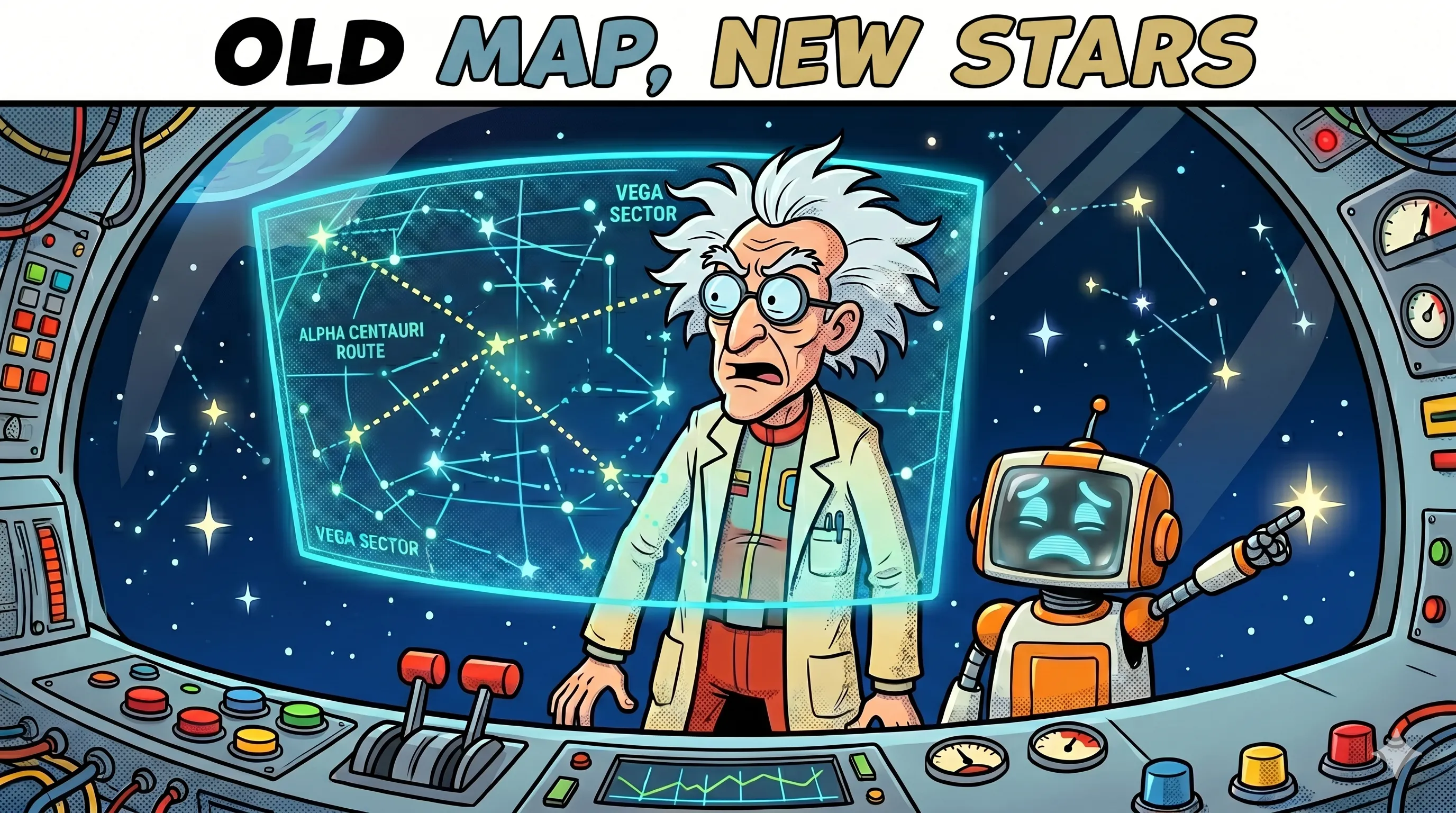
Your navigation AI was trained on star charts from last year. It could plot a course through any known sector with perfect accuracy. Then a rogue black hole drifted into Quadrant 7, warped the gravitational fields, and shifted every star in the region by half a degree.
Your AI has no idea. It’s still navigating by the old map. And every route it plots is now slightly, dangerously wrong.
The Scenario
You trained your model, tested it, got great results, and deployed it. For a few months, everything runs smoothly. Then, slowly, performance starts to degrade. No code changed, and nothing broke — the world simply moved, while your model stayed still.
This is drift. The data your model sees in production gradually stops looking like the data it was trained on.
The Reality
In machine learning, this is called Data Distribution Drift (or Dataset Shift), and it comes in several flavors.
Covariate Shift means the inputs change. A spam filter trained on 2024 email patterns encounters 2026 spam tactics — different vocabulary, different structure, same intent. The filter’s logic is fine, but the emails no longer match what it learned.
Concept Drift means the relationship between input and output changes. A model predicting “what users want to buy” was trained before a recession. Now the same demographic with the same browsing history makes completely different purchasing decisions. The rules of the game changed.
Label Drift means the definition of the labels shifts. What counted as a “high priority” support ticket a year ago might now be classified as “medium” because your team raised the bar.
You detect drift by continuously monitoring your model’s input distributions and prediction distributions in production. When you spot significant divergence from the training baseline, it’s time to retrain on fresh data.
The Why
A model is a snapshot of the world at the moment it was trained. The world doesn’t hold still. If you deploy a model and walk away, it will quietly rot. The predictions won’t suddenly break — they’ll slowly become less accurate, and by the time anyone notices, the damage is already done.
The Takeaway
Your AI is navigating by yesterday’s stars. If you’re not monitoring for drift and retraining regularly, your model is getting worse every day, and it won’t send you a notification about it.
AI specialists call it: Data Distribution Drift & Dataset Shift Distribution drift occurs when the statistical properties of the data a model encounters in production diverge from the data it was trained on. Key types include covariate shift (input changes), concept drift (input-output relationship changes), and label drift (target definition changes). Continuous monitoring and periodic retraining are essential.
💬 Have you ever relied on an old plan or outdated information way longer than you should have? What finally made you realize it was time to update?
Part 18 (Data Distribution Drift) of 20 | #DLLifecycleForHumans #ai_edu Based on CS230 Stanford lectures