The Robot Crew: Team vs. Conveyor Belt
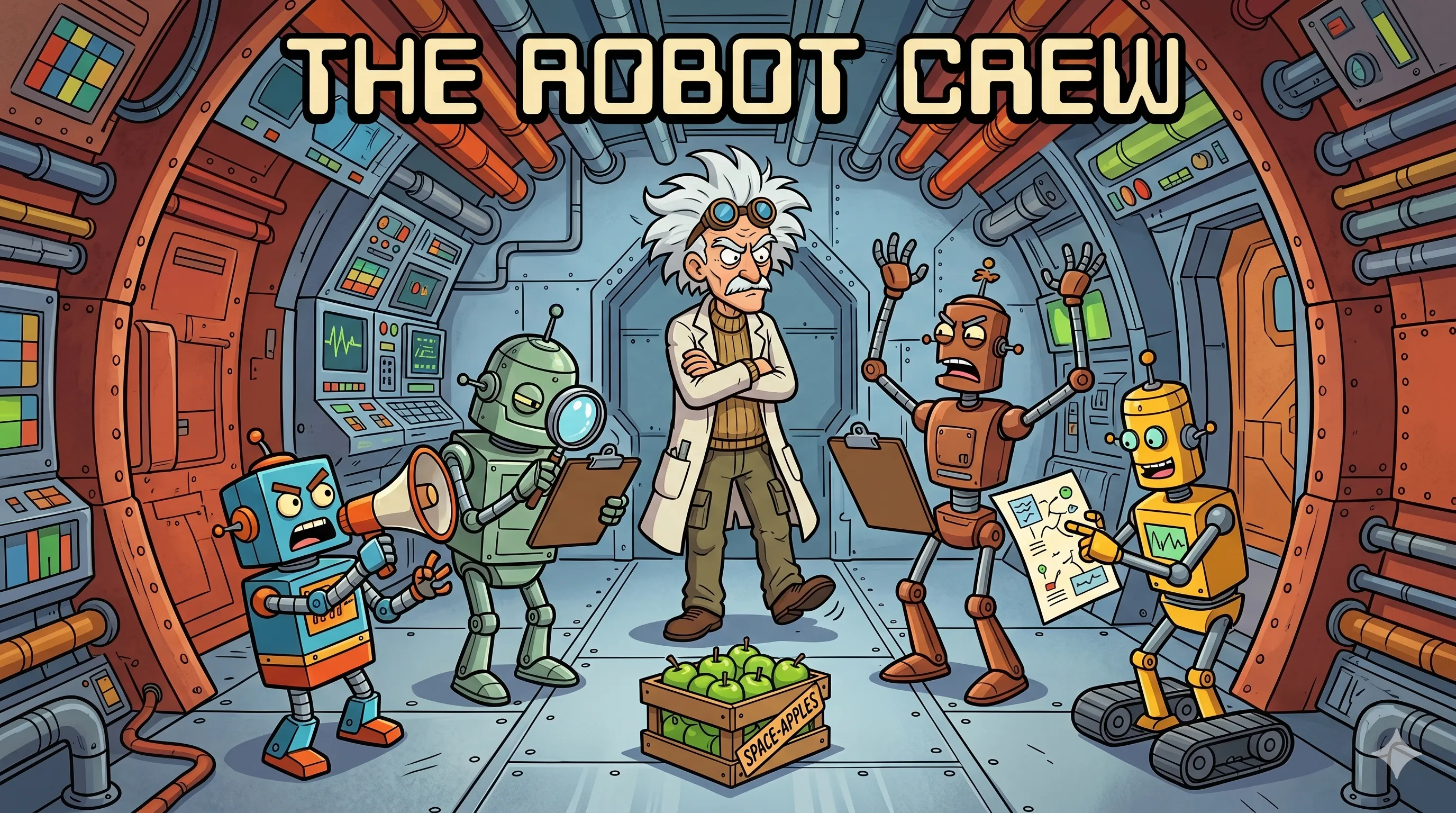
Your robotic crew of seven specialized droids is currently standing in the cargo bay, arguing. The Captain droid is waiting for a status report from the Logistics droid, which is waiting for the Inspector droid to verify a shipping label, which is currently stuck in an infinite loop because the label is slightly smudged. Meanwhile, a single crate of space-apples sits on the floor. It has been there for three hours, and you’ve already spent $400 in energy cells just keeping the droids powered.
This is the reality of the agent craze in AI. When people realize that a single AI model can’t solve a complex, multi-step problem, their first instinct is to build a complex team of digital agents. They assign roles, build communication channels, and let the models talk to each other.
But most of the time, they just built a very expensive, very slow way to do something a simple script could do in seconds.
The Scenario
When we talk about AI, we usually think of a single model: you type a prompt, the model processes it, and it spits out an answer. This is single-shot inference. It is cheap, fast, and works for 90% of tasks.
But some tasks are too complex for a single shot. If you ask a model to write a full software application, it will likely fail. It can’t think ahead, test its own code, or fix its own bugs.
To solve this, developers build agentic systems. Instead of a single prompt, they create a loop:
- Plan: The model decides what steps to take.
- Act: The model uses a tool (like running a python script or searching the web).
- Observe: The model looks at the tool’s output.
- Reflect: The model evaluates its progress and decides whether to continue or try a different approach.
When this works, it looks like magic. The AI can write, run, test, and debug code without human intervention. But when it doesn’t work, the droids spend all day talking to each other in the cargo bay while your apples rot.
The Reality
Agentic systems are not a free upgrade. They introduce three massive challenges:
- Latency: A single model call takes two seconds. An agentic workflow might require fifty model calls back-and-forth. The user is left waiting for minutes.
- Cost: Fifty model calls cost fifty times more than one. If your agent gets stuck in a loop, it can run up a massive bill in minutes.
- Reliability: The more steps in a chain, the higher the chance of failure. If the model makes a minor mistake in step 3, the entire plan derails by step 10.
This is why you shouldn’t use agents just because they sound advanced.
The Why
So how do you decide when to deploy the crew and when to stick to a single model?
Look at the nature of the task. If it has a clear input, a clear output, and a predictable path, use a single model (or a simple chain of hard-coded steps). If you are classifying customer support emails, a single model is your conveyor belt.
But if the task is open-ended, requires active troubleshooting, and cannot be solved without feedback from the environment, you need an agent. If your AI needs to connect to an API, read the error message, write a fix, and try again until it succeeds, a single shot won’t work. You need the loop.
The Takeaway
Build a conveyor belt whenever you can. Only hire the robot crew when the path is too unpredictable for a fixed track.
AI specialists call it: Agentic Workflows vs. Single-Shot Inference Single-shot inference involves a single input-output pass through a model. Agentic workflows introduce loops of planning, tool use, observation, and reflection. While agents can handle complex, open-ended tasks, they suffer from high latency, high API costs, and lower reliability due to cascading errors. Use them only when feedback loops and tool interaction are strictly necessary.
💬 Have you ever tried to automate a simple daily chore, only to spend three times as much time fixing and maintaining your automation? What was it?
Part 19 (Agentic Systems) of 20 | #DLLifecycleForHumans #ai_edu Based on CS230 Stanford lectures