The Parachute in the Trunk: Why Tabletop Disaster Recovery Fails When Cloud Regions Go Dark
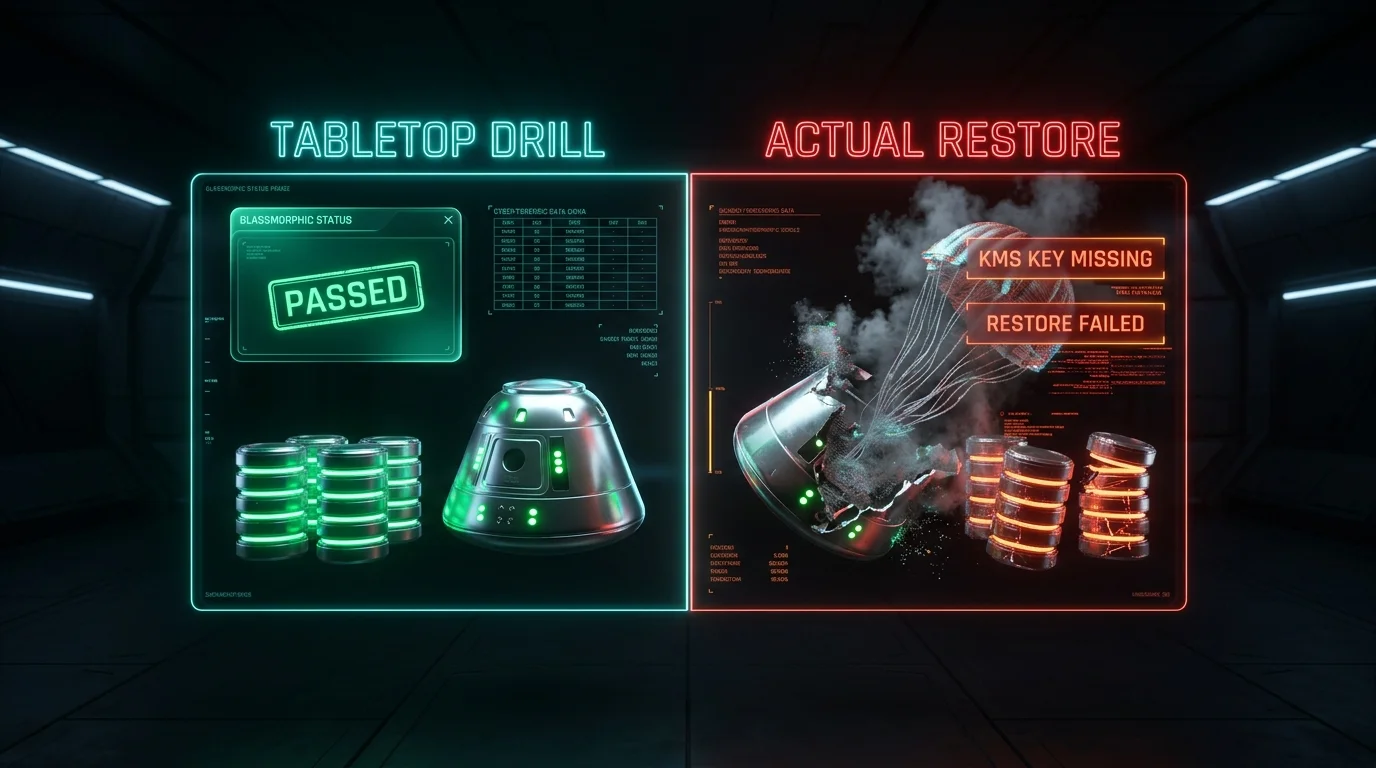
Once a year, usually three weeks before the external SOC 2 or ISO 27001 audit window closes, four engineering leads book a conference room, order lunch, and open a Google Doc titled “Annual Disaster Recovery Tabletop Exercise.”
For sixty minutes, they walk through a hypothetical outage aloud:
- “If
eu-central-1goes offline, how do we recover?” - “We point Terraform at our secondary region, pull the daily encrypted RDS snapshot from S3 replication, and swap DNS records in Cloudflare.”
- “And how long does that take?”
- “Should be under four hours. Everything is automated.”
Someone types Status: PASSED at the bottom of the Google Doc, captures a screenshot of the AWS Backup dashboard showing green checkmarks, exports the document to PDF, and uploads it to Drata or Vanta. The auditor checks off ISO 27001 Control 5.30 (ICT Readiness for Business Continuity) and SOC 2 Availability Criteria.
Nobody actually restores a single byte.
That annual meeting is the equivalent of tossing a folded parachute into the trunk of your car, confirming the nylon bag has no visible rips once a year, and certifying yourself ready to jump out of a plane.
What Actually Breaks in an Empty Cloud Region
When a catastrophic cloud outage, ransomware intrusion, or accidental infrastructure wipe strikes, teams discover that backups are an illusion until proven in a clean, disconnected VPC. Real recovery efforts collapse on four predictable failures that tabletop slides never catch.
1. The KMS Key Deadlock
Enterprise teams dutifully enable encryption-at-rest across all database snapshots and S3 buckets.
When disaster strikes and an engineer attempts to restore the replicated snapshot in a secondary region, the restore fails with KMSKeyNotFoundException. The automated replication copied the encrypted data blocks, but the original Customer Managed Key (CMK) policy remained bound to the compromised account, or the IAM execution role in the recovery region lacked kms:ReEncrypt and kms:CreateGrant permissions.
Your backup data is intact. Mathematically, it is pure white noise without keys trapped inside the dead perimeter.
2. Circular Bootstrapping Dependencies
Every modern team claims their infrastructure is reproducible with Terraform or OpenTofu.
When engineers execute terraform apply against an empty recovery region, the pipeline stalls instantly. Where is the Terraform remote state file stored? In an S3 bucket inside the primary outage zone. Where are the private container images pulled from? A private Harbor or ECR registry that depends on the corporate VPN that is currently down. Where do the CI/CD secrets live? Inside an active Vault cluster whose DNS resolves to the unreachable VPC.
You cannot use a production cluster to bootstrap the replacement for that same production cluster.
3. Asynchronous State Drift Between Datastores
A tabletop checklist assumes the database holds the truth. Production systems hold state across fragmented layers:
- PostgreSQL relational tables backed up at 02:00 UTC.
- S3 user uploads replicated asynchronously over 15 minutes.
- Vector database indices (Qdrant or Pinecone) rebuilt hourly.
- Kafka event logs retained for 72 hours.
Restoring a database snapshot to 02:00 UTC alongside an S3 bucket state from 02:14 UTC breaks referential integrity across thousands of rows. Application workers wake up, find database pointers to missing files or missing vector embeddings, and crash in tight restart loops.
4. The RTO Fiction
Every Business Continuity Plan submitted to European regulators under DORA (Digital Operational Resilience Act) or enterprise clients states a comforting Recovery Time Objective: RTO < 4 hours.
Nobody times how long AWS RDS actually takes to hydrate an 8-terabyte snapshot from cold storage across availability zones, rebuild B-tree and HNSW vector indexes, warm connection pools, and propagate TLS certificates. In real outages, just restoring and validating multi-terabyte storage routinely consumes 14 to 24 hours—before the first engineer even troubleshoots application boot errors.
The Engineering Fix: Automated Ephemeral Restore Drills
Auditors accept PDF screenshots of tabletop discussions because the standard asks for proof of testing. The mistake is running manual theatrical meetings instead of building a weekly automated pipeline that proves recovery works end-to-end.
Modern compliance engineering treats disaster recovery as a continuous integration job running against an isolated, zero-trust sandbox environment.
[Weekly Cron Trigger (Sunday 03:00 UTC)]
                  │
                  ▼
[Provision Ephemeral Recovery Sandbox VPC]
                  │
                  ▼
[Cross-Region Snapshot Decrypt & Restore] ──► Fails? ──► [PagerDuty Alert: DR Broken]
                  │
                  ▼ Succeeds
[Run Synthetic Integration & Schema Probes]
                  │
                  ▼
[Measure Actual RTO Seconds + Destroy Sandbox]
                  │
                  ▼
[Push Signed JSON Evidence to Compliance Vault]
Instead of trusting green dashboard badges from AWS Backup, a scheduled GitHub Actions workflow or Jenkins worker spins up a fresh database clone using only the credentials and Terraform variables that would exist during a real regional wipeout:
import boto3
import time
import psycopg2

def execute_dr_verification(snapshot_arn, kms_key_id, target_subnet_group):
    rds = boto3.client("rds", region_name="eu-west-1")
    start_time = time.time()
    clone_id = f"dr-drill-{int(start_time)}"

    try:
        # 1. Test cross-region restore and KMS key accessibility
        rds.restore_db_instance_from_db_snapshot(
            DBInstanceIdentifier=clone_id,
            DBSnapshotIdentifier=snapshot_arn,
            DBInstanceClass="db.r6g.large",
            DBSubnetGroupName=target_subnet_group,
            KmsKeyId=kms_key_id
        )

        waiter = rds.get_waiter("db_instance_available")
        waiter.wait(DBInstanceIdentifier=clone_id)

        endpoint = rds.describe_db_instances(DBInstanceIdentifier=clone_id)[
            "DBInstances"
        ][0]["Endpoint"]["Address"]

        # 2. Verify cryptographic integrity and schema row counts
        conn = psycopg2.connect(host=endpoint, dbname="prod", user="dr_probe")
        with conn.cursor() as cur:
            cur.execute("SELECT COUNT(*) FROM financial_ledger;")
            ledger_rows = cur.fetchone()[0]
            assert ledger_rows > 0, "Restored ledger empty!"

        actual_rto = round(time.time() - start_time, 2)
        return {"status": "VERIFIED", "actual_rto_seconds": actual_rto, "rows": ledger_rows}

    finally:
        # 3. Clean up ephemeral test infrastructure
        rds.delete_db_instance(DBInstanceIdentifier=clone_id, SkipFinalSnapshot=True)
Why Compliance Teams Should Demand Machine Logs Over PDFs
When an external auditor reviews your SOC 2 Type 2 controls or an EU DORA inspector evaluates your operational resilience, handing over an unverified meeting summary signals process theater.
Handing over 52 consecutive Sunday JSON logs showing:
- Exact timestamp of the automated cross-region clone
- KMS decryption verification under isolated disaster-recovery IAM permissions
- Verified synthetic transaction row counts
- Measured
actual_rto_seconds: 1842.4
leaves zero room for ambiguity. If a developer changes a KMS encryption key policy on Tuesday and silently breaks disaster recovery, the automated drill triggers an immediate engineering alert on Sunday morning—months before an outage or an audit.
A backup is not a compressed archive sitting in an object store. A backup is a verified restore path running from scratch.
If your primary cloud region went permanently dark right now, what is the exact date you last verified that your team holds valid decryption keys and non-circular scripts to bring the database back online?