From Q-Tables to Deep Q-Networks: When the Cheat Sheet Melts
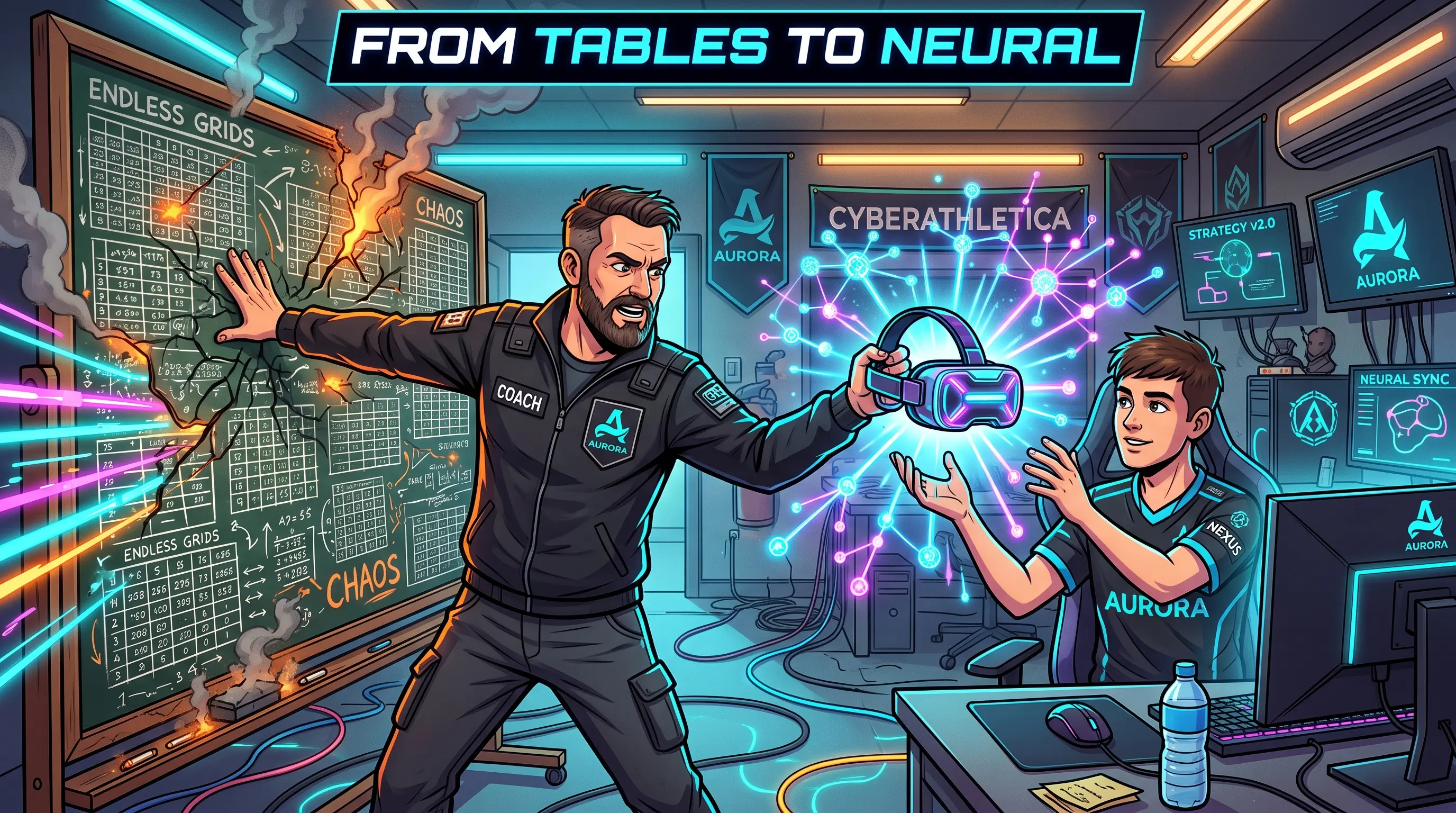
Imagine coaching a rookie for Tic-Tac-Toe.
You can scribble a complete cheat sheet on a paper napkin: if the opponent plays top-left, you play center. If they play center, you play top-right. There are only a few hundred board states. A simple two-column spreadsheet can easily store every possible scenario and tell you the exact point value of every move.
In Reinforcement Learning, that cheat sheet is called a Q-Table.
Now imagine trying to use that same spreadsheet strategy to coach a player in Counter-Strike, StarCraft, or Rocket League.
Every single frame on a 1080p monitor contains over two million pixels, each capable of displaying billions of color combinations. An enemy could peek at 99 health or 14 health, walking, jumping, or holding a smoke grenade. The number of unique visual screen states is vastly greater than the total number of atoms in the entire observable universe.
If you tried to build an Excel spreadsheet with a row for every possible game screen, the file size would collapse the planet into a black hole.
A master coach doesn’t hand a player a trillion-page binder. The coach trains an instinct engine.
The Reality
In early reinforcement learning, agents relied on a Q-Table: a literal lookup grid where every row is a State, every column is an Action, and each cell holds a Q-Value (the expected future reward for making that move).
This table works beautifully for small grid worlds, but shatters the moment you step into the real world. This is the Curse of Dimensionality.
In 2015, DeepMind broke this barrier with Deep Q-Networks (DQN).
Instead of trying to store a lookup table, they replaced the spreadsheet with a Deep Neural Network. You feed the raw screen pixels into the neural network, and instead of searching an impossible database, the network estimates the Q-value for every button on the controller in a few milliseconds.
The Why
The power of a neural network isn’t memorization; it’s generalization.
A neural network doesn’t need to have seen your exact screen configuration before. Because it learns high-level visual features—like “that moving blob is an incoming bullet” or “that doorway leads to safety”—it can make sound tactical decisions in situations it has never encountered in its entire training run.
It transforms an impossible filing cabinet of memorized snapshots into a flexible engine of digital intuition.
The Takeaway
Memorization only works when the world is tiny; when reality becomes infinite, you need an engine of intuition.
AI specialists call it: Deep Q-Networks (DQN) / Value Function Approximation
Instead of storing tabular Q-values Q(s, a), DQN parameterizes the Q-function using a deep neural network Q(s, a; θ). The network takes high-dimensional state representations (such as raw pixel frames) as input and outputs estimated Q-values for all discrete actions, trained by minimizing the Mean Squared Error against the Bellman target.
💬 Have you ever tried to memorize rigid rules for a complex real-world task, only to realize that true competence came from developing intuition?
Part 4 of 15 | #ReinforcementLearningForHumans
#ai_edu Based on Stanford and industry lectures