Competitive Self-Play: How Battling Your Own Clones Creates Superhuman Tactics
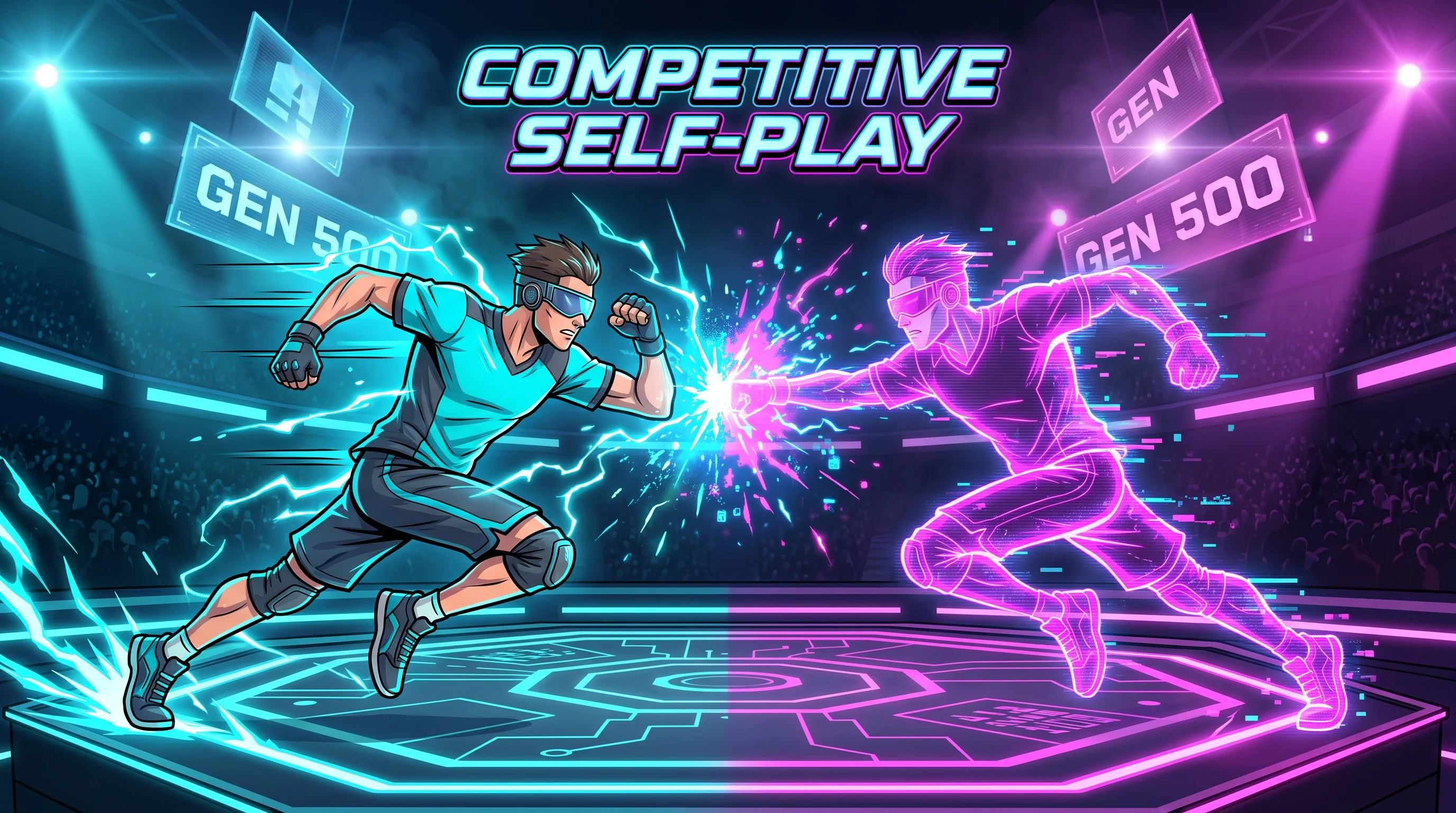
If you only practice tennis against a mechanical ball machine, you will master the machine in three weeks.
You learn the ball launcher’s exact cadence, angle, and spin. Eventually, you can return every ball with your eyes closed—not because you became a world-class player, but because you memorized a machine that never learns back.
The moment a human opponent steps onto the court, spots your tendency to favor your forehand, and drops a delicate backspin slice just over the net, your scripted muscle memory falls apart.
For decades, AI research hit this exact ceiling.
When engineers trained game-playing algorithms against scripted rule-based bots, the AI quickly found a cheap exploit in the bot’s hardcoded logic. It would spam that single move endlessly to rack up points, and then stop learning entirely. The environment offered zero incentive to develop deeper strategy because the opponent never adapted.
In the 1990s with backgammon (TD-Gammon), and later at massive scale with AlphaGo, AlphaStar, and OpenAI Five, researchers discarded scripted opponents and unlocked an engine of boundless progression: Competitive Self-Play.
The Reality
Instead of playing against a static bot or human match recordings, the agent plays games against past copies of itself.
At the beginning of bootcamp, two identical rookie networks stumble across the arena, taking random, chaotic actions.
When Player A accidentally stumbles upon a basic flanking maneuver, it crushes Player B. But Player B is also a learning algorithm: it analyzes the defeat, invents a tactical defense, and turns the tables.
Now Player A must invent a counter to Player B’s counter.
Without a single human coach intervening, the system generates its own curriculum. Millions of simulated matches create an evolutionary arms race where neither side can ever rest on a single exploit. Every tactical discovery instantly becomes tomorrow’s target for destruction.
The Why
This arms race produces emergent tactics—strategies that were never programmed into the software and had never been seen in human history.
In 2016, during Game 2 against legendary Go grandmaster Lee Sedol, AlphaGo played Move 37 on the fourth line. Professional commentators gasped and initially called it a catastrophic beginner mistake; no human professional had played that stone in hundreds of years of recorded tournament history. It turned out to be a match-defining strategic masterstroke that fundamentally altered how humans understand Go territory.
In Dota 2, OpenAI Five stunned professional championship squads by buying back fallen heroes in the opening minutes of the game, sacrificing valuable late-game gold reserves to secure immediate map control. Human pros had avoided early buybacks for a decade, dismissing them as reckless waste; OpenAI Five proved that early map tempo outweighed the gold penalty.
Where does this break down?
Self-play can fall into circular traps, known as non-transitive dynamics or the Rock-Paper-Scissors loop. If Strategy A beats Strategy B, B beats C, and C beats A, an agent training only against its latest clone can cycle endlessly between these three postures, forgetting earlier lessons while convincing itself it is making progress. DeepMind resolved this in StarCraft II by creating AlphaStar League: instead of battling only the newest model, agents compete against a diverse roster of past checkpoints and specialized exploiter bots designed solely to expose narrow tactical blindspots.
The Takeaway
Practicing against a fixed opponent guarantees a plateau the moment you solve their habits; boundless mastery requires competing against yesterday’s version of yourself.
AI specialists call it: Competitive Self-Play / Emergent Gameplay / Population-Based Training (AlphaStar League)
In multi-agent reinforcement learning, self-play frames policy optimization as a two-player zero-sum game: min_θ max_φ E[V(π_θ, π_φ)]. In symmetric zero-sum games, fictitious self-play and regret minimization converge toward a Nash equilibrium. To overcome non-transitive game dynamics (cycles in policy space) where standard self-play cycles endlessly, frameworks like AlphaStar (Vinyals et al., 2019) deploy population-based leagues consisting of main agents, league exploiters, and main exploiters, ensuring robust counter-strategy coverage across the full meta.
💬 Have you ever worked alongside a competitor or colleague where every technique one of you figured out instantly forced the other to reinvent their entire approach?
Part 11 of 15 | #ReinforcementLearningForHumans
#ai_edu Based on Stanford and industry lectures